Jokes on them, my private repos are total dog dookie. If nobody but me can see the code then I don't have to worry about style, structure, comments, or any other best practices.
You don't want an LLM trained on my private repos. Trust me.
Or this: https://www.epirusinc.com/electronic-warfare if you think the C-RAM would get saturated. Whether the weather balloon drones move at night is irrelevant if you stop the last move they need to make.
Militaries have been defending themselves against attacks for as long as they've been around. Drones will change the way they fight a little, but it isn't going to be some magic pill that modern militaries can't adapt to. Hiding an explosive and then blowing it up when your target is nearby? That's almost the same concept as assassinating someone with a car bomb. Putting it in an Amazon box and letting the drone go the final distance changes things a little, but militaries and governments were able to assassinate people remotely before drones.
Swarming attacks with cheap munitions? Saturating an enemy's defenses has been a thing at least since the time of the English Longbow. The longbow regiments would all shoot at the same time, and while you could dodge one arrow it was hard to dodge all of them.
Drones are new and will take some adapting to. If a military refuses to change then it probably will be disadvantaged. But the US military has been buying and testing drones for a while, and is already undergoing the adaptation. As it better understands cheap drones for offense, it necessarily gains a better understanding of what is needed for defense.
To be clear, I'm not advocating for the US attacking Iran. All I'm saying is that the US military is not about to lose the conflict because of this particular tactic.
How's that going to work when the drone hugs the ground, only rising a bit to hop over walls? Are you going to flatten everything a mile around every base, and shoot at head height with zero warning?
> Leonidas EWS
How's that going to work when the drone doesn't show up on radar and has fiber-optic controls?
If drones were this easy to counter, we wouldn't be seeing them play such a massive role in the Ukraine war. The whole problem is that drones massively change how a conflict works, and the entire US military is designed for pre-drone warfare. It remains to be seen whether they can adapt quickly enough fast enough for this conflict - the US doesn't exactly have a great track record when it comes to asymmetrical warfare...
> Are you going to flatten everything a mile around every base, and shoot at head height with zero warning?
Yes. You've obviously never seen a C-RAM in action. They will put 20 mm rounds in any angle that isn't restricted. The rounds go far beyond a mile when fired into the air. Only a few hit the target, dozens/hundreds of rounds just sail off into the distance, and if it hits a village down the road, well that's just too bad. Shooting downward into the dirt is probably a better arrangement because ricochets won't go as far.
> How's that going to work when the drone doesn't show up on radar and has fiber-optic controls?
Tiny drones do show up on radar. Tiny birds show up on radar. Making a quadcopter or similar drone stealthy kills some of the value proposition on making them cheaply, and physically shrinking them lowers the amount of destructive payload they can carry. Fiber optics don't help against a directed energy weapon- the microwaves burn out the electronics; it's not a jammer, it's a heat ray. And if there was a fiber optic line, that means the attacker is close enough to be struck directly rather than some long-distance control or autonomous program.
Before you think you've solved warfare and that a modern military can't possibly defend against your brilliant tactics, learn about what warfare is actually like and how the systems work. A lot of your ideas have already been thought out. A loss of a single helicopter is not really an indictment of the US military's defense; the fact that there's only one of these stories vs. the many that have come out of Ukraine indicate that a US base isn't nearly as vulnerable as the Russians have been. While Ukraine is punching far above its weight, their adversary is hampered by (more) corrupt acquisition processes, poorly trained conscripts, and overall bad decision making.
That first paragraph is a good argument for using this defense in occupied land, less so for domestic bases per the hypothetical. It becomes laughably bad if the target is changed from military to civilian; the defense seems likely to cause as much or more damage.
This is partly why most military bases are not in a city- open space makes it easier to defend. (Another reason is that the dangerous chemicals and loud training make residents hate the base even in peacetime.)
And attacking civilian targets is a violation of the law of armed conflict. It would be a war crime if a country were to use drones (or any weapon) to intentionally attack civilians who are not participating in the fight.
I don't even know why people are still arguing. The US has been bombing Iran for nearly a month now. If drones and drone tactics were a particular weakness, why hasn't the US lost more equipment because of it? Out of 25 losses recorded for the US only one has been because of a drone. The US has lost more due to crashes and friendly fire than enemy drone action. Until drones are more effective than just someone not paying attention then it's hard to make an argument that there is a serious weakness. https://en.wikipedia.org/wiki/List_of_aviation_shootdowns_an...
The speedup labels on the vertical axis are 0, 2, 2, 4, 6, 8... Why is 2 repeated? Did they just have nano-banana make them some charts? Can they not be bothered to use matplotlib or bokeh and directly render a graph? I don't know, maybe there is some legitimate reason that I don't know about for making a single value occur multiple times on a graph axes, but if that is the case, then they probably need to explain it in the figure caption. So it's either a "GenAI special" or it's poor communication about how to read the graph...
Do you have literally any clue what Polar Quantization is? Would this make me think, "I kind of have a high level understanding of that, let me go get the details from the paper."
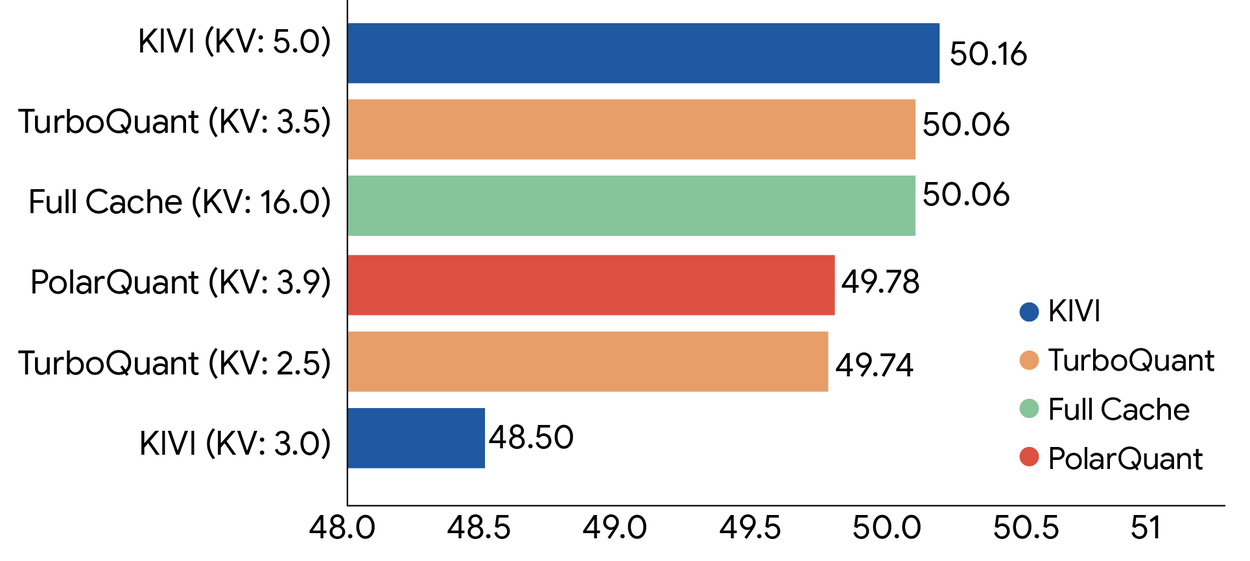
The left hand side of the graph, which is normally assumed to start at 0, starts at 48. Those MASSIVE differences you see in the figure? Only a few percent. And that's a deception but only if the figure is even accurate, because we saw earlier they can't even get figure axes correct.
Yeah, the viz for polar quantization is straight up nonsensical. Okay, so some colors are converted into clocks and then into a bigger box with a pink box inside of it. Got it. Even understanding what polar coordinates are doesn't help you make sense out of it.
I don’t feel good about this case- on the one hand, I’m all for sticking it to big corporations. On the other hand, nobody has claimed that Meta and YouTube were doing anything illegal, so this case is different from civil suits brought after a criminal case finds someone guilty. This is a case where the jury decided they don’t like how two corporations acted, and are just giving money to one person. Why does this plaintiff in particular deserve this money?
I’ve argued in the past that the right way to create the change in corporations we want is to change the laws, and people have made valid points that Congress has basically given up on doing that. But even so, civil cases with fines don’t seem like that way to make lasting change. In the analogues to the tobacco fights, there are LAWS that regulate tobacco company behaviors as a result. The civil case here isn’t going to result in any law. So what are companies supposed to do? Tiptoe around some ill defined social boundary and hope they don’t get sued? Because apparently the defense of, “no I didn’t target that person and I didn’t break any laws” is still going to get you fined. What happens when a company from a conservative location gets sued in a liberal location for causing a social ill? Oh, we’re cool with that. But what if a company from a liberal location gets sued in a conservative location for the same thing? Oh, maybe we don’t like that as much. I’m taking the libertarian side here. I know plenty of people who don’t watch TV, don’t use Facebook, and I know plenty of people that recognized that they were spending too much time on digital platforms and decided to quit or cut back. So a healthy person can self regulate on these apps, I’ve seen it and done it. I’m just not sure how much responsibility Meta and YouTube bear in my mind. If they’re getting fined $3M plus some TBD punitive amount, are we saying that this 20 year old person lost out on earning that much money in their life or would need to spend $3M on therapy because of Meta or YouTube? It feels a little steep off a fine for one person.
If Meta and YouTube really were/are making addictive products, wouldn’t a lot more people be harmed? Shouldn’t this be a class action suit where anyone with mental trauma or depression be included?
I don’t know the details of the case, but I highly doubt that this one plaintiff was targeted specifically, and I doubt their case is that unique. I read tons of news articles about cyber bullying, depression, suicide attempts, and tech addiction. Does every one get to sue Meta and YouTube for $3M now?
If I sell you gizmo, and I know, or should know, that using the gizmo could seriously harm you, and I don't tell you or do anything about it, I am liable for damages you incur.
I’m not sure the plaintiff’s mental harm was caused by Meta and YouTube. You can be just as depressed without social media and online videos. And even if they were, other cases that are kind of similar to this have not found the corporation responsible. The parents of Sandy Hook didn’t get any money out of Remington, and their product is much more directly linked to harming people than an app. McDonald’s was not held liable in 2002 for making people fat. I am pretty sure the food at McDonald’s is more easily linked to our health outcomes than the link in this case.
Should Apple or Samsung be held liable for making the phone that the plaintiff probably used to use these apps? How much responsibility do they bear?
Further, Facebook/Instagram and YouTube are free products from the perspective of the plaintiff. These corporations didn’t sell anything to the plaintiff, so can they even be held liable? They did sell the plaintiff’s data to advertisers, which I think you might be able to hold them responsible if they misused that data, but this isn’t what the case was about.
I’m not rooting for depression or suicidal thoughts or anything, but this doesn’t feel like the right direction we need to be moving in as society. We can’t simultaneously argue for free speech and freedom of choice and also claim that we aren’t capable of making our own choices to live our lives responsibly.
I was just pointing out that the basic framework of the case is not some novel new idea, and a jury just decided to stick it to a big company out of the blue. There is a long history of this sort of case, and a jury did hear a lot of evidence from witnesses and instructions on the law from a judge.
Some of your examples are not very compelling.
In the case of Remington, there was another party that (presumably) the jury found was more directly responsible. Also, the victims of sandy hook were not Remingtons' customers.
Apple does not make you install instagram on your phone. And I doubt that you could find really compelling evidence that Apple knew in great detail the harms that were being caused, and rather then seek to mitigate them, instead made them worse in order to earn more money.
I'm not sure there a requirement that a product be paid for in order to be subject to product liability law.
I think I agree that these product liability cases are not the best way for a society to deal with these problems. I would prefer to see the democratic process arrive at some reasonable solution, based on the desires of the majority of the population. But there has been almost no movement in that direction, and I have my doubts there will be (in the US).
And I think it's important to see that this is about 16 (and younger) year old children, not adults.
> Apple does not make you install instagram on your phone.
Meta did not make her install Instagram on her phone.
> I'm not sure there a requirement that a product be paid for in order to be subject to product liability law.
You’re the one who originally used the word sell when pointing out this case was brought as a product liability case, not me. And selling something is the first step in establishing product liability. But even if the court allowed a liability case to go where there was no commercial sale, Meta and YouTube could have argued that their product would not be considered defective/harmful by a reasonable person- almost by definition the number of users of Instagram and YouTube make that argument- and thus they should not be liable for one person claiming a defect.
Like I said before, this should be a class action. One person doing it is a money grab and the jury just wanted to stick it to “big bad tech companies.” I probably wouldn’t care so much if they had found Instagram liable but excluded YouTube, but the fact that YouTube has to pay some of the damages means the jury was not thinking that hard.
The article isn’t implying that Trump is going to seek a ceasefire because of some puny bets on Polymarket, it’s implying that someone (or multiple people) close to Trump heard he was considering a ceasefire and placed a bet before Trump posted about it and the odds went up. Or they at least knew that him posting about it would affect the ours enough to make money, whether he plans to negotiate a ceasefire for real.
Most countries would not need to make their C2 infrastructure fully dependent on Starlink, because most countries are not big enough and cannot project enough power globally to make this an actual requirement, and the few countries who can project power globally can afford multiple communications layers. But your core idea is true.
This is explicitly one reason the US marketed the F-35 so hard to their allies. In addition to giving their allies a good capability, it made their air force dependent on continuing US support, so politicians wishing to go against US positions have to be willing to sacrifice their military power to do so. This gives the US a strong lever in negotiating.
This is what the US’s defense production act is for. If a company makes a critical product, the US has openly stated that it will compel a company to prioritize making that product in times of need. They can’t refuse. This is also why the US wants all of its key systems to be US made- they cannot be held hostage by a foreign entity.
There’s obviously a few areas where this isn’t really true, like a foreign company setting up a US company to sell their product, but by and large the US is immune to the risks you describe. China similarly makes most of their own systems and is mostly immune. A large scale WW3 between the US and China cannot be stopped by a company refusing to participate.
In this case, yes, this is probably a violation of the law as it is written. But I doubt law enforcement even notices or cares. You’re not actually doing anything to the kids. Maybe hypothetically you’re not setting/respecting an age flag in a web browser, but that’s the worst thing going on.
So it’s a nice statement but ultimately hollow because the devs aren’t at any real risk of being arrested or fined. This isn’t like Rosa Parks refusing to move to the back of the bus.
Want to make a real statement about software freedom? You gotta do something that makes the normies mad, like making an OS that explicitly helps kids do sports betting, buy drugs, watch porn, and whatever else. Then people will notice, but unfortunately you probably won’t convince them that this law is bad.
Unless Microsoft, Apple, or Google refuses to comply then I think this law is where commercial OSes are headed. But Linux doesn’t really need to worry, because nobody is going to arrest a nerd waving his arms saying, “look at me everybody, I’m breaking the law!”
Until the normies come in droves because their dear leader decided that it’s illegal to speak ill of him on a computer, or whatever drives mass change. The regulations will follow, and they will say what we were doing the whole time is impossible and would never work.
It's a consumer product safety law anyway. It won't be the police knocking down anyone's law, it will be whoever comes after you if you release a product containing 1% more arsenic than the legal limit.
I love this and I love seeing that it's from 2026 and someone still took the time to do all this testing- it must have been seriously involved because even at 6x it takes a while to fill up a DVD, and then to repeat that hundreds of times on several discs would be an eternity.
I haven't used a DVD+-RW in several years, as wireless file transfer over networks and flash drives handle pretty much all of my needs now, but I sure used the heck out of my DVD writer when I had it. I had no idea these discs could go hundreds of writes before failure, I always got paranoid about reliability and probably never went above 20 writes on a disc.
Edit: at the end of the post the author says, "that’s about 4020 hours across two drives, 5248 burns and both drives are still seemingly operating just fine." What a colossal amount of time.
For archiving, DVD is 4 GB and who knows how long the medium will last.
LTO-6 drives go for 300-500 EUR refurbished. You need a FC switch or HBA. Each tape holds 2+ TB uncompressed data.
As for NVMe, if you do a lot of writes (e.g. DB's, Docker), go for enterprise. If you do that, grab one with PLP. You'd use it also as a cache for ZFS.
Fibre channel HBAs really cost peanuts. Because there's tons on the second hand market and the only ones who want them are enterprises who don't buy second hand shit without a support contract (they usually dump them when the support is up, that's why there's so many working ones on the market)
So I get €300 cards for €20, it's a joke. Really great though because they're really amazing for tying storage together and they can do point to point just fine. No switch needed.
The one drawback is the convoluted software chain around it, I used to work with SANs but if you don't it might require a little investigation :) The client side is pretty easy, the target side is harder (this is the part that is normally covered by a SAN).
But the biggest problem with LTO drives and home use for me is the terrible noise they make. If 3D printers sound like robots having sex, this is more like robots getting tortured.
I made a mistake in my post. I meant to say FC HBA or SAS HBA. I went with a SAS one which I use with a HBA, but the FC ones were cheaper (both FC LTO drives as well as FC HBAs) but would've still required a FC switch). I already got some fiber through my house though, so it'd have worked well. But I went with SAS which was considerably more expensive. 40 dB ain't fun, indeed. I put my LTO drive in the fuse box.
As overseeing backing up, from various optical media to disk, just don't use the optical stuff!
This was a huge international conglomerate, doing CD backups for decades. Now it turns out these precious backups only worked 96-98% of the time. Terrible stuff.
Actually 96-98% is not great but not terrible if you're employing some kind of parity scheme across multiple discs. It just means 1 in 20 (or 1 in 10 to be safe) extra discs in the mix.
The oldest NVMe SSD I have at home is a Samsung 950 Pro (the 256 GB version!) which I bought in late 2015 IIRC (and put on a ASUS Z170-A mobo, that already had a NVMe slot) and which has been in use that whole time (but mostly light desktop use):
    Percentage Used:                    27%
    Data Units Read:                    48,801,760 [24.9 TB]
    Data Units Written:                 84,590,914 [43.3 TB]
    Power Cycles:                       228       <-- only 228 power cycles in 11 years, that's about 17 days uptime every time I think
    Power On Hours:                     37,153    <-- not sure about this one, this comes out at about 9 hours / day of uptime
And after 11 years it's still going strong!
Now it's not on my main computer anymore: I'm rocking a WD-SN850X (recommended here on HN when it came out) but the old Samsung 950 Pro is on the desktop computer my wife uses daily (and she WFH).
> I think SSDs can take quite the beating nowadays
For regular use definitely. In my servers I've got ZFS in mirroring though: you never really know when a drive is going to RIP.
Percentage Used: 0%
Data Units Read: 15,235,390 [7.80 TB]
Data Units Written: 33,573,616 [17.1 TB]
Host Read Commands: 107,051,408
Host Write Commands: 496,391,879
Controller Busy Time: 455
Power Cycles: 938
Power On Hours: 13,189
Thanks, I read your article and my main reaction is that I'm saddened by the loss of data on those few unreadable discs. I hope it wasn't something you'll need to dig up in a few years.
From my personal experience, the article and the comments I read here they seriously undersold the reliability of rewriting. For any other RW medium (audio or video cassettes, even floppies) I remember ad campaigns by Sony, TDK, Philips, … on tv. But not for these.
I feel in general the industry was more conservative making these kind of estimates than it is today. I assume they also benefited from years of CD-RW field experience honing the tech.
Ye, having experienced the "joys" of rewriteable CDs, I completely skipped the DVD RWs, expecting more of the same. Guess it wasn't, but then again, thumb drives became a thing.
This article is a total overstatement designed to boost stock prices and none of the actual users can counter the claim because it would require revealing classified information.
This is the same kind of claim you’ve all seen before about AI systems doing something amazing and it’s really just a bunch of people sitting in a call center in a third world country controlling the system remotely.
Only in this case it’s a bunch of senior airmen and staff sergeants sitting in an intel shop doing all the work. Sure, Palantir made a UI but it just plain sucks. And Claude probably fixed some typos in the targeting packages. But let’s not believe that either system was influential to target selection. CENTCOM created a similar number of targets at the beginning of the Syrian civil war before any of these LLMs existed and it took a similar amount of time. We ended up not striking them, but the plans were made after Assad used chemical weapons. All the fixed locations in Iran had packages written and sitting on the shelf before Trump was even elected the first time. The AI in this war added basically no value.
Any claim that Palantir did something useful for the government should immediately be viewed as suspect. I’ve used their software, and it sucks. I cannot understand how they got such big contracts to make a shitty UI that poorly integrates other systems’ data.
Do any end users actually use the Palantir AI? I've always assumed that the big customers of it would just put their own custom UI on it that was actually usable.



You don't want an LLM trained on my private repos. Trust me.
reply