Agrobot has a better strawberry picking robot in test. [1] Abundant Robotics has an apple picking robot in test. Not yet in production. Getting close, though.
Robotic weeding is now commercially available. Vision systems target the weeds, skipping the wanted plants. The weed is hit with an overdose of fertilizer, a laser, or just a powered hammer. Deere and Siemens both have machines for this.
It's coming soon. A cell phone has enough compute power for this.
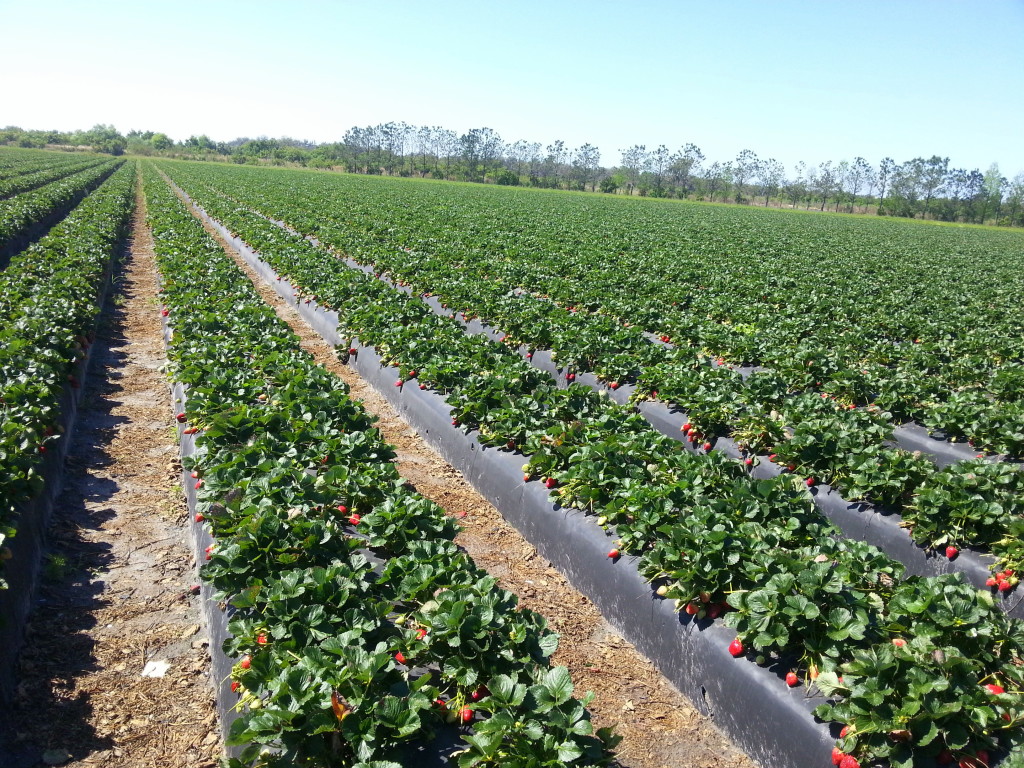
Strawberries are typically grown in somewhat raised beds, even if it's not as fancy as the pictures I'm seeing with the Agrobot. This is what a typically strawberry field around Plant City, FL looks like:
Rather that developing robots that fit into existing strawberry farms which are designed to make it easier for humans to harvest, they should be developing new types of strawberry farms which are designed to make it easier for robots to harvest. That could be combined with the indoor farm model too to bring other benefits, such as allowing all-year-round harvests, potentially bringing the food closer to the consumer, possibly assisting pest control, etc.
But yes, I've often thought strawberry harvesting would be a really interesting (and challenging) AI and robotics problem to work on.
>existing strawberry farms which are designed to make it easier for humans to harvest //
All the farms I've seen in the UK have just been fields, making harvesting very arduous work (that farms near where I grew up imported Eastern European labourers for).
A large proportion of strawberries are now produced in polytunnels using the matted bed or table top system. The former allows strawberries to be picked from a seated position from a wheeled trolley; the latter raises the strawberries to about chest height. Gross yields can be slightly lower and there's a significant capital cost for table top production, but it can work out cheaper overall due to easier organic pest control, higher quality and reduced husbandry and picking costs. We're likely to see a considerable shift towards table top production as brexit starts to bite.
Automation on farms would be a necessary move, its back-breaking work that you don't get to experience that is totally different from the u-pick experiences, they grow bushes very small (at about 1/8th the size of bushes you see in movies) with lots of fruits so that the bushes mature very early and need minimal space, all of which make picking it up very tiring, generally speaking the only people picking with me are either very nice "immigrants" or people I wouldnt want to walk home in the night with.
I once did it for some quick cash during my pre-highschool yrs, I quit very fast cos it makes much more sense just to wait tables for the same amount of money.
I find it amazing that with all the progress around us every day, people still think there is an impossible line automation can’t cross, and that their job is safe.
Even as a programmer, I imagine a lot of coding work being at the minimum offset by automation.
>I find it amazing that with all the progress around us every day, people still think there is an impossible line automation can’t cross, and that their job is safe.
Why don't have any contracts signed with nature on infinite progress. Or that any desired progress will be timely.
We might never be able to pass some local maxima.
Or we might go extinct, or go back to barbarism after a few good wars of famines, before we get to solve some problems.
Or it might take 50 or 100 years in the future to do so.
We still don't have personal robot (with bodies) assistants, flying cars, space colonies, or general AI -- all things that were considered (by experts nonetheless) "just around the corner" in the 60s.
And don't get me started on mass market holographic storage
and memsistors...
We still don't have personal robot (with bodies) assistants...
The vision of a having a robot assistant just shows the lack of imagination that people in the 1960s who were making these predictions. They couldn't see further than a mechanised version of what they already had. On the face of it a robot is a replacement for a physical person, but the reality is that the physical person bit is what's unnecessary. Automation of processes is largely about removing as much of the 'physical' bit as possible. What was needed was to distill the tasks down to the absolute minimum and then automate that, and that's what we've got now. We automated the physical side of posting a letter and now we have email. We automated filing by using databases instead. Scheduling meetings is now done using shared calendars.
Automation of jobs is not about making a machine that does the job of a person. It's about removing the person and building systems to replace the processes that person did.
We do have robot assistants. They just don't look like robots.
>The vision of a having a robot assistant just shows the lack of imagination that people in the 1960s who were making these predictions. They couldn't see further than a mechanised version of what they already had.
I'm not so sure. A robot assistant would be very much desired by thousands, as a general replacement for another human (e.g. domestic server, personal trainer, bud to play tennis with, arbitrary help around the house, and don't get my started on sexbots).
>* Automation of processes is largely about removing as much of the 'physical' bit as possible.*
That might be so, but humans are not factories, and a nice general help anthropomorphic robot would still be very much appreciated. The same way general AI is the holy grail considered to 10000 dedicated processors that can play chess or translate for you.
As you point out, the future is a strange beast to pin down.
It's amazing how people are ready to throw capitalism and scientific advancement out of the window because of where advancement might be headed at some distant point in the future.
Let me know when unemployment shows a trend of rising over the long term because people can't find new lines of work. Then let's talk about putting UBI or other draconian measures in place.
>It's amazing how people are ready to throw capitalism and scientific advancement out of the window because of where advancement might be headed at some distant point in the future.
Notice the world "headed" -- it's as if it's all out of human control, and the best they should do is strap in for the ride, to whatever it is.
What you characterized as "amazing" can also be described with words like precaution or prudence.
For at least some of those things just around the corner, they could have been here, tax cuts and the occasional vastly expensive defence gewgaw were chosen instead.
tax cuts and the occasional vastly expensive defence
Then again, maybe tax cuts allowed private companies to get us further than where we would have been if we had spent ever-more money on government. Maybe defense spending is what kept communism and the Soviet Union from setting progress back a hundred years.
>Maybe defense spending is what kept communism and the Soviet Union from setting progress back a hundred years.
When they gave up the ghost they weren't that behind. And when they started operations back in 1917, they were vastly behind the US. Plus they got to space (and tons of other space related things) first.
So there's that...
Not to mention the plethora of government funded stuff we take for granted in the West as well -- the internet (ARPA) and the web (CERN) for starters...
(And most of early computing, also heavily subsidized)
The USSR achieved some narrow technical/space/military successes by focusing themselves on those few things and utterly subjugating and impoverishing the rest of their society. And in the end, they couldn't even keep that up. They burned out their economy and produced conditions that could easily have resulted in a civil war there.
There's a reason the USSR felt the need to construct Potemkin villages.
A lot of coding has already been automated. We don't write programs by manually punching the bits in anymore and programs that once were a major project are now homework exercises for students.
Luckily the demand for programming has so far outstripped any productivity enhancements.
Not only is it automated to a degree, but a lot of the tech stack is shared so we can achieve a lot more quicker. But it still outstrips demand by far.
Re: Even as a programmer, I imagine a lot of coding work being at the minimum offset by automation.
Most CRUD applications could be about 90% defined by filling in data dictionaries (tables describing tables). However, trends & fads, mostly UI fads, keep mucking up the details of the implementation. Sometimes UI-related trends are good, but a good many are just wasteful fads. Bosses, users, and customers like shiny fancy dancy new things. Vulcans would puke.
Fads are great for creating jobs because they keep moving the goal-post: often being different JUST to be different; but fads are lousy from a pure efficiency standpoint. Humans are still apes who follow the shiny red things.
"You could afford to give people a day off, you know. Afternoons off, holidays off. If you have machines behind you."
One of the major issues I have with discussions around automation is that they always look at it from either the point of economics or the point of technology.
Those are important perspectives but we tend to look back in history to determine what will happen in the future.
If technology keeps progressing and economics keep making it cheaper and cheaper to do more then the real question is where does that really leave humans. Our advances as a species is by the invention of new technologies which has allowed us to store more and more knowledge/information/data from trial and error in the past while at the same time allowed us to spend less and less time on surviving. In other words, human ingenuity and advances are based on the technology.
What many seem to forget is that once AI learn to pick strawberries it has learned a lot of other things too which can be applied to other industries/tasks and it's instantly applicable (no need to retrain workforce). In other words each step forward isn't isolated to the area that the AI is learning about it allows for the advance of technology in a number of areas.
And so here is the problem.
Human progress has historically followed the progress of technology which was fine as long as it made many things easier. Human ingenuity helped us keep adapting and venture into new areas. But what we are increasingly facing is technological ingenuity.
I can't really tell from the video, but they would, in addition to knowing a strawberry was behind a leaf, need to know if they were ripe or not --so they would have to push leaves out of the way to tell visually via color if they were ripe; unless there are other signals that could be used. Basically, "presence" is not equal to "ready for picking".
Agreed. But since the article mentions the current system not being able to detect strawberries behind leaves, they'd have to adapt it to one, detect a strawberry behind foliage, two determine readiness for picking.
So, yes, moving leaves and color works for people, but is that also the best method for an automated mechanical system?
Don't know about best, but it could work. I'd easily imagine some horribly spider like appendage expertly pushing leaves aside and sticking a little camera in there, probing for them little berries.
So a hypothetical strawberry variety that ripens simultaneously would help this by eliminating this step?
Also, ripe strawberries are quite different in mechanical properties from the green ones, I imagine that ultrasonic methods could possibly be useful for this too.
My thoughts exactly. I've always though the whole artificial eye thing was often unnecessarily limiting the range of perception (and thus capabilities) to what humans are accustomed to.
Maybe part of the answer is in the form factor of strawberry plants. Like olives for instance. They grow olives now in windrows of little bushes, like a low hedge and harvest them with a machine that straddles the rows. Which obviously is a lot more efficient then getting them out of a tall tree.
You're comparing harvesting from a tree/small tree to harvesting from a vine that, by nature, always grows very close to the ground. Many plants in strawberry fields are maybe a foot high (often less), and very dense.
Point being we don't have to grow things in their natural forms. And we often don't. Olives, after all "by nature" are big trees (which was the point, not to suggest growing strawberries exactly like olives).
And this is without even talking about selective breeding for a different form factor for strawberries. Never mind severe genetic alteration we can do nowadays.
We seem to have a problem with "something like" in this thread.
Not talking about literal baskets or literally growing strawberries like olives. Those are just examples of different growth form factors that 1) allow automation and 2) clearly show the strawberries on the outside.
Just a bit of a rant. If everything has to be explicit robots are going to take your jobs kids. Need to be able to think in general principals to stay safe from that.
Well, if you look at the picture in the strawberry basket link I posted you will clearly see the strawberries hanging outside the vine in plain view, solving the problem of strawberries hidden under the leaves that can't be seen by the machine.
"Hey, it could happen! Put a man on the moon, didn't we?"
I think it's funny cause as a ML engineer I can totally understand why it's in many ways easier to get people to the moon and back than to solve dynamic leaf occlusion and object segmentation at scale.
Having grown up around Johnson Space Center and the decommissioned Saturn V on display, I think this is more of a "technically true" misnomer. It's true in the same way we don't have the technology to build a 69 Camaro anymore because we dismantled it and have no desire to, not because we have lost the technical capability.
The difference between the technology to build a 69 Camaro and a vehicle to take us to the Moon (heh, among many) is that the technology to build the Camaro has steadily evolved into the technology we use to build cars today, whereas we literally stopped making Moon transfer vehicles about 50 years ago and literally haven't made anything since that is capable of doing it again.
It's not the the technology hasn't advanced. There's been a lot of improvements in aerospace manufacturing techniques and materials since then. It's just the cost vs interest isn't there.
In the case of the US the space shuttle program was the big disaster. Keeping them operational consumed so much of NASA's budget that they couldn't afford to develop a heavy lift vehicle. That and the bloated US military industrial pork complex can't make anything on time and on budget.
> It's not the the technology hasn't advanced. There's been a lot of improvements in aerospace manufacturing techniques and materials since then. It's just the cost vs interest isn't there.
Isn't that a distinction without difference?
We have the technology to solve world hunger, it's just the cost vs interest isn't there.
We could be sending people to the moon monthly if NASA got out of the business of building launch vehicles. The first version of the SLS will be only lift slightly more than the Falcon Heavy, yet each launch of the SLS will cost over $2B while the Heavy costs $100M.
In your example the replacement technology is demonstrably better and more capable. We don’t have replacement technology for the moon lander or even the shuttle.
Though I suppose you could argue sending robots instead of people is better?
I can only guess that you're being downvoted because you want a replacement technology for the Space Shuttle. That's still a pretty divisive issue, as the some people blame the shuttle for NASA not developing new launch vehicles for 30 years, as they spent so much effort maintaining the shuttles.
I think the SpaceX approach is working better, at least for now, where you attempt reusability, but not for a long time. It's like a Harbor Frieght tool -- use it like 3 or 4 times before it's toast. But SpaceX hasn't yet had the fun of launching passengers, so it's really not a fair comparison.
So true. I think of technological capability as of a cultural artifact these days. In the sense that you can’t really just start making something sophisticated right off the bat, you have to build the culture that enables you to do it, slowly, bit by bit. You can certainly try to cargo cult, but you won’t really get anywhere if you don’t have the intangibles.
> "You could afford to give people a day off, you know. Afternoons off, holidays off. If you have machines behind you."
What total bullshit. No advance in mechanisation has ever resulted in this happening. What happens is that the workers get the days off, but it's not holidays, it's being unemployed.
>No advance in mechanisation has ever resulted in this happening.
Can you point to some source of this information? I'm asking because when I look at the data I see that for example industrial revolution was correlated with:
1. Reduced length of a work-day.
2. Increased lifetime expectancy as well as overall quality of life.
3. Elimination of child labor.
And all of this happening while general population was growing.
The 40 hour week was not a gift of tech. It was a hard fought labor struggle. And, if you haven't noticed, we haven't moved that needle again after introducing computers.
How are you reaching those conclusions? If I recall history correctly 1 & 3 were the products of a generations class warfare and more than one massacre at the hands of industrialists. The labor movement rose in hand with the industrial revolution, but it’d seem a perversion to portray those gains as some inevitable beneficence of increased mechanization.
Those benefits came later, and slowly, after a lot of struggle for worker/female/child rights. Initially you had kids working 10h a day in coal mines because of the industrial revolution, steam machines needed the coal to run. Many people lost their jobs. There was of course also many great benefits, like cheaper textile making clothing much more affordable. With time the work force adapted to the new conditions, found new jobs, factories opened, and slowly the benefits outweighed the horrors of the transition.
Work day length actually increased dramatically during the early industrial revolution. Early factories frequently required 10-14 hour shifts, seven days per week. It was only the labor movement pushing back that resulted in a shorter work day and week. Even then, it's unlikely that the current work day or week are significantly shorter than they were in pre-industrial Europe. Meaning the labor movement really only brought us back to something resembling a reasonable baseline. Even if pre-industrial agricultural laborers worked longer days or weeks during periods of maximum activity, they did so seasonally, with long periods of relative rest between harvesting and planting seasons.
Ultimately it is political conditions, rather than technological, which determine typical working period lengths. For example, despite relatively little difference in technology or economic activity, African-American agricultural workers in the US South shifted to dramatically shorter working periods following abolition. Only the political conditions of slavery enabled slave-owners to compel a longer working day than would normally be tolerated by workers.
And while technology can increase the amount of surplus wealth generated, it can't change the distribution of that surplus (at least not on its own). Factory work increased the value per hour produced by laborers but it took labor organization and mass strikes to shorten the work day. It took women's suffrage and widespread moral outrage to stop child labor (which was far harsher in early factories than it ever was in agriculture). It took government intervention via social security and medicare to extend the life-expectancy of average laborers (in the US, though the equivalent programs in other developed countries had similar effects).
Basically, employers aren't going to give time off or other benefits just because they want to or just because they can afford to. At least not in any great numbers. They're going to do it because political or market conditions compel it, such as when Henry Ford increased the pay of factory workers dramatically to prevent them from working for his competitors. But market conditions are stacked against the laborers getting greater benefits in this situation. Employers are substituting robots for their labor and so their labor is less in demand and thus demands a lower price (benefits + pay). So with increased mechanization and automation, the average laborer can't demand more benefits in the market while still maintaining wages. Barring political/legal pressure, employers will simply pocket the surplus from this situation rather than charitably donating it to their workers in the form of PTO or other benefits.
It isn't necessarily bad that workers get laid off, because that frees them to pursue more remunerative or fulfilling activities. But we can't rely on employers to help workers transition after disruption in the labor market, just as we couldn't rely on employers to set reasonable working days or to not hire child laborers.
The problem is that the number of jobs that a completely unskilled person can do better than a robot are rapidly diminishing, and there already aren't enough to go around. To achieve this utopia, we need to invest in much better education for everyone, and we need to do it 30 years ago at least. An unskilled labourer made unemployed at 40 or 50 has nowhere to go.
> To achieve this utopia, we need to invest in much better education for everyone, and we need to do it 30 years ago at least. An unskilled labourer made unemployed at 40 or 50 has nowhere to go.
In the general sense, this might not work since white collar jobs are also subject to automation. For example, we don't need as many lawyers combing through legal documents when search algorithms can do the job. If anything, it's easier for computer systems to manipulate digitalized information than work in the physical domain.
In a more specific sense, if for example USA invested more in education, it would do little to help those who would be replaced by farm automation. The majority of farm workers are immigrants on temporary H2A visas or undocumented: http://nfwm.org/education-center/farm-worker-issues/farm-wor...
It's true that white collar jobs are under threat too, I'm in the UK so less aware of how the US labour market operates, but in both countries we have issues with people for whom there simply are not jobs.
Globally, this situation is pretty worrying. How do we share resources when input is not even required from most people? How do we keep people occupied and give them purpose in life? People without purpose in life are the ones who will happily vote/act to trash the system after all.
I've thought for a while that if you really want to change the world, find a way to profit from unskilled labour in the Western world (where minimum wages, welfare systems exist) in a distributable and scalable way, that can't be replaced by robots.
Approximately 15% of the population have an IQ less than 85. Education isn't the solution for this group. For most in this group, picking strawberries is challenging and rewarding. (For the lower 1/3 of this group, picking strawberries is too intellectually challenging as it is.)
Hand-waving and saying 'job training' and 'education' isn't a solution for about 10% of the population. I don't know what the solution is. But, the number of people who are excluded from the marketplace due to tech is increasing rapidly. Not good to have 15%+ of a poulation unemployable. Leads to breakdown and instability.
I don't believe ability is tied in 15% of the population to fundamental brain reality. It's more tied to experience.
If more people are brought through the experiences, they will be able to perform the tasks. It's accumulating failures through experience, and then repeating the actions that causes skill. Not some magical IQ.
How much time have you spent amongst the lower 15%? Ever lived in a trailer park? Every lived in the projects? I doubt it. It's not a knock on you. But, it's very easy to live one's life without encountering those with sub-85 IQ. They ain't online, you know. Most wouldn't be able to figure out how to use the Hacker News interface.
You know, the U.S. military won't take someone with an IQ less than 85... they're too dumb to even learn how to clean a rifle.
In any case, no amount of experience or education will enable someone who lacks mental ability to function at a tech job. There are those who will never -- even with months of hands on training -- be able to grasp opening a Word DOC. What do we do with them? It's about 15% of the population.
The number of employed people in the US grew from ~100 million in 1980 to about 155 million today. That happened while automation accelerated and while China and India entered the global economy.
It seems that jobs on average now are "lower quality" than jobs then, but maybe the better take on that growth, given the headwinds, is that it has not been so bad?
That's just because the population has been growing (yes, there are 44% more people now in the US since 1980).
The employment ratio of population has steadily dropped. Economists call it the 'labor participation rate', and it has declined quite markedly since ~2000 or so:
"The lack of labor force growth going on nearly a decade now means that in every likelihood there remains a deep pool of American labor from among which Americans would work if there was any (at the margins) to be hired at a decent rate."
Right, but my argument isn't that things are all gravy for people working low paying jobs, it is just to point out that many many jobs have been added.
It's fairly clear that more jobs would be better for the US work force; it's less clear whether automation is the main thing driving the reduction in job "quality" and labor force participation.
Particularly if at the same time we are trying to achieve an egalitarian society where an unskilled worker is only financially marginally worse off than a skilled worker.
Your point has validity to it. But that can't be used to stunt the growth of automation industry.
My father works primarily on building various automation units in textile factories. I'm hazy on the technicalities, but one such unit he built a few years ago crushed coal and fired it into a huge furnace, the heat of which is used by the factory for various purposes. Most factories in the city use these units now. Before that however, there were men (there still are). They'd work in shifts of 10-12 hrs everyday. Shirtless, they shovelled coal into mouth of the furnace non-stop until the furnace was hot enough, take a break of 10-15 minutes, maybe less, and start again. And these weren't small kitchen furnaces, these were huge. At 20 feet away, you can feel the heat envelop and drain fluids from your body (a small 'mis-flare' nearly burnt my father's face). The city easily touches around 43 °C (109 °F) in summers, so it's not like we live in a cool place either. You should see how their bodies look. These men toil away their entire lives on extremely cheap labour, contract all kinds of diseases, and when their sons grow up, they get into the same business, because that's the only thing they know and it's "financially risk free". And there were so many of them. In short term, sure the machines take away jobs. In the long term they take the entire demand away. When pushing against automation, people forget that modern society currently stands on the back of such people. The faster we automate these, lesser number from the next generation gets into these. It should be easier to solve unemployment IMHO.
Those out of work for the decade(s) while the economy retools wont see it as short-term. And the 'freeing' of labour in one place drives down the cost/wages elsewhere. The more useful thing in the short term will be things that previously nobody ever wanted/needed to do.
There are a few areas where automation made the workers life easier without replacing them. Aircraft autopilots reduced workload without eliminating pilots. Same too for many hand tools that a made carpenter's life less painful without any concept of replacing them.
It indeed was not clear about the specific problems. It basically implied that it shouldn't pick all strawberries, just a subset, probably the most ripe. But it didn't describe well what the bot keeps getting wrong.
I suspect people use tactile feedback in addition to sight, but that is difficult for bots to get right because it requires lots of contact sensors, lots of processing, and lots of coordination with vision to tune well (at our current stage of AI). But it does sound like it's getting incrementally better such that the bots' time will eventually come. I wonder if a spectragram could reduce the need for tactile sampling? That's something a bot has up on humans.


Robotic weeding is now commercially available. Vision systems target the weeds, skipping the wanted plants. The weed is hit with an overdose of fertilizer, a laser, or just a powered hammer. Deere and Siemens both have machines for this.
It's coming soon. A cell phone has enough compute power for this.
[1] https://www.wsj.com/video/agrobot-automates-the-work-of-berr...