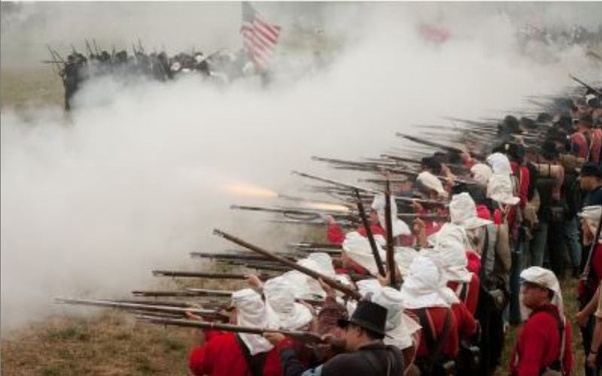
The British red coats were a kind of dazzle camouflage, making it hard to see individuals within the group. People weren't stupid back then - they just had different design goals to what we have now.
In addition, C2 was not what it is today, so an important design goal for military uniforms was to distinguish friend from foe on the battlefield.
In the same vein, modern militaries often attach IR strobes to personnel and vehicles to identify them at night. This will likely appear silly in a few years when night optics are pervasive (if that hasn't happened already).
"Lieutenant! We're sticking out like sore thumbs here! Why did we go with bright-fucking-red as our uniform colour? The enemy can clearly see us coming!"
"Corporal, your job is to bang on that drum as we march, not complain about military fashion."
As I just said, the design consideration wasn't to not stick out.
'Shock action' is a modern military term, but that's partly what they were trying to achieve in those days through visual impact. 'Shatter the enemy's cohesion and will to fight' is something they were trying to achieve through visual impact.
As another example today, think about why the UN paint their vehicles white. It's because their visibility and presence on the battlefield provides a tactical effect.
I didn't think that UN peacekeepers appeared on battlefields - don't they normally stay in their bases, or patrol peaceful areas? There usually has to be some peace before the peacekeepers rock up.
What advantage would it provide to make it harder to distinguish individual soldiers? Wouldn't their enemies just volley fire into the mass of red coats, instead of picking and choosing?
> What advantage would it provide to make it harder to distinguish individual soldiers?
Distinguishing individual soldiers is an important step in counting the size of a line. Accepting "red coats blend together" as truth, that would make it more difficult for an opposing general to determine which parts of a battle line were stronger or weaker, thus making it more difficult to preposition forces to exploit weak sections.
Once the battle was joined the camouflage effect would not have mattered as much, but before the deployment of radio it was also very, very difficult to change battle plans "on the fly."
When determining weaker sections visually, wouldn't you go by "mass" of soldiers? I don't think anybody would count individual soldiers.
In any case, given the technology of the time, if you were beyond engagement range, I don't think you would have been able to pick out individual soldiers by sight regardless of which uniforms they were wearing...
My theory is that vibrant color uniforms were chosen simply to make identification of different formations easier.
It helped to identify friend-vs-foe yes, but not formation, as formations were distinguished by the lining of their uniform, which wasn't very visible!
Also red was just an easy colour to get hold of and to dye with, and it hid blood.
The red mass of undistinguished soldiers created an imposing sight on the battlefield. It's not about wanting to hit individuals (why would you?) it's about the shock factor.
This is only infantry as well - where shock action was even more important - cavalry - and distinction didn't apply - you had less uniform more elaborate uniforms.
Wikipedia (I know, I know) seems to imply it was simply that the die was common, that it was a traditional symbol of an English soldier, and for identification of friend vs foe:
> However, in the days of the musket (a weapon of limited range and accuracy) and black powder, battle field visibility was quickly obscured by clouds of smoke. Bright colours provided a means of distinguishing friend from foe without significantly adding risk. Furthermore, the vegetable dyes used until the 19th century would fade over time to a pink or ruddy-brown, so on a long campaign in a hot climate the colour was less conspicuous than the modern scarlet shade would be. As formal battles of the time commonly involved deployment in columns and lines, the individual soldier was not likely to be a target by himself.
and
> In his book British Military Uniforms (Hamylyn Publishing Group 1968), the military historian W. Y. Carman traces in considerable detail the slow evolution of red as the English soldier's colour, from the Tudors to the Stuarts. The reasons that emerge are a mixture of financial (cheaper red, russet or crimson dyes), cultural (a growing popular sense that red was the sign of an English soldier),[64] and simple chance (an order of 1594 is that coats "be of such colours as you can best provide").
There is no mention of "dazzle" camouflage or of confounding numbers at all.
It's funny because zebra stripes don't make them harder to be seen by lions. There was an article about this on HN, showing the low-res vision of lions cannot tell stripes or no stripes at a distance.
Apparently zebra stripes have more to do with reducing fly bites, among other things.
Camouflage was absolutely not a goal of 18th century uniforms. When you are wheeling around infantry units like big blocks camouflage is more or less tactically irrelevant.
Furthermore, if they were trying to blend in with each other like one big homogeneous mass of infantry they wouldn't have given everyone hats in a contrasting color.
The goal of their uniforms wasn't to hide individuals within the environment, but to make it hard to discern individuals within the imposing mass of soldiers.
The goal of their uniforms (and other colorful uniforms of that era) was to make units visible to the commanders on their side, so that they could grasp the arrangement of the battlefield easily, and know where to e.g. send a messenger to relay orders.
That doesn't explain why early-modern generals adopted costumes with extremely distinctive hats. Napoleon's hat, for example, was meant to allow troops to discern him instantly.
Flamboyantly colored uniforms of the time also helped prevent friendly fire. Each volley of musket fire filled the air with a white smoke cloud. [1][2]