As an European I don't mind buses at all. I neither feel unsafe nor I find them dirty.
A single bus carries on average 20 times the people cars occupying the same space would (as you rarely get more than 1 person per car in peak hours).
I'd rather take buses than the car in any city. Cars make cities dangerous, noisy, polluted, congestions make people nervous behind the wheel, fights are far from uncommon. Finding parking, paying for it is another issue, common in Europe where (luckily) city centers are often millenia older than cars.
At no point of me living in the US I found the car-centric model anywhere better.
Maybe it goes without saying, but the reason you don’t mind the bus in Europe is not because you are European but because the European buses are nicer.
The things you say about noise and pollution are also true in the US, and American drivers are acutely aware of them. But the alternative is not a European bus, so people drive.
>> Maybe it goes without saying, but the reason you don’t mind the bus in Europe is not because you are European but because the European buses are nicer.
Actually I think it is both. Car culture in Europe is nowhere as dominant as it is in the US. Many Europeans grow up with public transportation as the default mode of getting around. So they are more likely to be accustomed to things that become grievances for Americans.
I was born and raised in Turkey, and now live in the US. In Turkey when you take a bus or train during rush hour you’re often packed like sardines. No concept of personal space. Same with many cities in Europe. That type of thing wouldn’t fly anywhere in the US, except maybe NYC. Even then though New Yorkers tend to dislike it.
There's an intimidation factor that a lot of Americans won't quickly admit to when it comes to taking the bus. They don't know if they can tap with their phone to pay, if they need cash, if they can use change, if they need exact cash/change, if they need a specific transit card etc. They don't know the etiquette for asking to get off the bus and sometimes it varies by bus design. They don't know the routes or the time schedules and find it confusing and overwhelming and often have a low tolerance for the embarrassment that can come with publicly learning something.
Yes. As long as we're looking for relatively easy or cheap improvements, I believe that UX is a huge one. Buses have a long tradition of user-hostile design. "Exact change only", unhelpful and condescending and impatient drivers, unwritten etiquette rules, and everything else you listed.
It has always baffled me why they make it so hard for first-time users in particular. Sure, they mostly care about the regular customers who make up 99% of their passengers, but everyone has to be a first-timer before they can be a long-timer. It's not just UX papercuts, the experience seems designed to be maximally hostile. Is it because one more marginal person is a little more delay, a little more crowding, etc? It feels like there are perverse incentives at work.
> Buses have a long tradition of user-hostile design. "Exact change only"...
On every pay-in-cabin bus I've ever ridden, this is synonymous with "No change given". The machines are quite happy to accept more money than is needed for a single ticket, and the reason for that is pretty obvious.
> It has always baffled me why they make it so hard for first-time users in particular.
The SFMTA (the San Francisco bus/train operator) provides a document that addresses almost everything you brought up. [0] The "unhelpful and condescending and impatient drivers" thing isn't addressed, but I've never run into a Muni driver that was anything but helpful. [3] As an added bonus, the most useful information about fares is posted on the paybox inside the bus.
>> Buses have a long tradition of user-hostile design. "Exact change only"...
> On every pay-in-cabin bus I've ever ridden, this is synonymous with "No change given". The machines are quite happy to accept more money than is needed for a single ticket, and the reason for that is pretty obvious....the most useful information about fares is posted on the paybox inside the bus
That's fair, but (1) when I was a kid and starting out riding a bus, I didn't know that; and (2) as that same kid, neither my family nor I had very much money at all and paying "extra" for something is just not something you do. Consider it a cultural thing. "inside the bus" is good but insufficient when I'm deciding between walking a mile or chancing the bus that I don't understand. (I almost always walked the mile. I was cheap, and I hated looking stupid in front of unsympathetic people.)
As for Muni, I didn't live where I could use it until I was no longer that kid. But adult me fully agrees with you. My experience with Muni has been much better than with most other busses I've used.
I see. Your complaint is that in vehicles that are staffed only with a driver, the driver refuses to handle change, and that -in your youth- your parents didn't provide you with any information (whether directly from them, or published by your local transit authority) about how mass transit worked in your area.
There's not much the transit authority can do about your parents' decision to leave you ill-informed. I can tell you that obligating the solo driver to handle change would be significantly user-hostile for the passengers currently on the vehicle. The tradeoff made is the correct one.
As you're probably aware, there's also good news: for a while now, many (most?) transit systems permit payment with radio cards that are linked to a preexisting pool of money, rather than having to handle cash inside the vehicle.
Your post is a good illustration of the type of hostility I'm talking about. "If you don't already know, it's your fault, and if it's not your fault, it's your parent's fault."
I don't want the driver to handle change. I want to know what the price is before I board the bus and possibly discover that I do not have the right change (or enough money at all). Yes, I would also like the machine to give me change if I overpay. I'm demanding.
My parents do not know so cannot teach me. They live on a farm. When they visit cities, they rely on their social ties and meet someone to take them around. Plus, well, it was a farm; I had no need for buses until I moved away. There is no mass transit in the area I grew up, so there's no literature to peruse.
I apologize for not being gifted with the evidently superior parents you had.
I was not unusual. Many rural people moved to cities and ran into all this implicit knowledge that they were looked down on for not possessing. It's ok; we laughed at the city folks who came visiting or relocating to the country too. We also helped them with a straight face, or at least helped those who could be helped. The social contract is stronger in the country than in the city.
But anyway, this is veering away from the crappy UX of most buses. It is true that I could have researched bus systems before I ever encountered one and trained myself such that I could survive the bad UX. But that's kind of the point, right? UX design should require as little prior knowledge or understanding as possible (as in, as possible without harming the experience of regular riders too much or increasing cost excessively; I acknowledge the existence of tradeoffs.) You try to make it useful to country bumpkins, non-native speakers, youth, the poor, etc.
It's the same in Europe. There are many car drivers who would never admit that, but they just don't want to leave their comfort zone and learn how to use public transport. But when asked they will say stuff like "well, we live a bit outside the city", or "now with kids you basically need a car".
Do you have any sources on that? In basically any European country the car dominates and is used far more than public transport. Even in cycle-friendly Netherlands the majority of people go to work by car.
That's not majority of trips, it's by distance travelled.
Basically in the Netherlands, if you're within 5-10km, you go by bike. If public transport is reasonable, which it mostly is in urban areas, you take it. You'd almost never choose car within a major city, unless it's on the outskirts.
Point still stands that public transportation is not the default mode. There isn’t a country with the cycling infrastructure of The Netherlands. And The Netherlands only has that cycling infrastructure due to its urban sprawl and low density cities. In most places in Europe you walk to your doctor, supermarket or cafe.
Make it legal for kids to move around on their own and take transit to school, just like they do in most of Europe and beyond. Parents are lazy, so many kids will. That's a lesson in public transportation use right there.
> Make it legal for kids to move around on their own and take transit to school
... it is legal though? But if you live in the typical US suburb then good luck with that. You'll catch a district provided bus to school and if your parents don't want to drive you somewhere you'll ride a bike or just not go.
Taking the bus in the suburbs often means walking 15 minutes, waiting on 45+ minute service, and switching routes at a transfer station. It's an ordeal to say the least.
Yeah suburban bus service really just doesn't work. Not enough density. I live in a small town and they try but it's the same issue. Most buses drive around nearly empty and just slow down the cars that are following.
There is also the monetary angle. How many european households can afford a car for both parents and a car each for two kids, registered, insured, paid for to park wherever they go?
Even if you are poor in the US cars are remarkably accessible. You can finance a used car with no credit and a couple dozen dollars a month.
The two basement levels in a complex that size are often parking, but the distance to the grocery store is a real factor. When the city is made of 10-story apartment complexes, the economics justify a grocery store every 10 minutes walk in every direction.
Do Americans really have to practice walking before going to visit Europe?
Many more households could afford it then want to afford it. Its just a huge waste of money. Cars are assets that massively deprecate in value and are utilized a extreme minimum of time. They are a horrible investment of large amounts of money.
In the rare cases where you need a second car, you can rent one extremely easily.
> Even if you are poor in the US cars are remarkably accessible. You can finance a used car with no credit and a couple dozen dollars a month.
This partly true but also really ignores a lot of issue that it creates.
The amount of car debt in the US is crazy. Lots of people get cars at absolutely absurd interest rates because their credit is bad and the need a car. Stretching out payment over many, many years. Its extremely predatory.
And then because of the arms race where everybody needs an ever bigger car or get killed, people buy more and more expensive cars all the time.
And of course because of the lack of safety inspections, people driving these really badly maintained crap cars that cause issues for everybody.
And even worse, people are so afraid of being without a car that people rather give up their homes and live in their cars then the other way around. Letting people slip into homelessness because if they want any hope in the future they need a car.
People paying interest on car loans rather then investing in their 401k isn't a great deal for society.
So yeah, my parents could defiantly afford two cars, but very, very rarely did we have 2 cars. And the only in special circumstances where that second car would be shared with some other people as well. Its just bad business and not that useful.
I calculated this back when I commuted daily. I was spending €700 a month on my car. Public transport would have been only €450 a month.
Still went by car. Car was 35 minutes door to door in a climate controlled environment with a good seat and good stereo system. Public transport was two hours, multiple legs with various trains and busses, various payment systems, problems with missing connections, waiting outside in the cold, being packed with others.
Gladly paid that €250 a month for 31 hours of my time and having a peaceful commute.
Plus a weekend trip was typically around €30 for four people versus €150 for four people by public transport.
Are you taking into account depreciation of the car and interest? Are you taking into account the cost of your parking spot?
Also, you example is just that. It will depend on many things. In places that are properly designed often the difference is nowhere near as large and the difference in money is bigger.
Also, in places where there is lots of public transport, when you get a universal ticket, you can also use it for free for everything other then commuting. Its completely normal to do all your other activities by public transport as well. When I go out and I want to have a drink, a car is not an option (unless people are just pieces of garbage, witch the US system makes almost inevitable).
> having a peaceful commute
Except of course that all of US popular media is full of people who have horrible long commutes suffering from stress and road rage.
Sitting in a train is more peaceful then driving by a lot. I can literally read a book and drink coffee or as I often do simply have a nap.
That was including all associated cost for both forms of transport.
This was in The Netherlands, which has one of the best public transport in the EU so I expect it to be worse elsewhere.
If you already have a car, you typically do your other activities by car as well since you already paid for insurance and road tax and it is significantly cheaper to go by car as you only have gas, wear and depreciation to pay for.
The universal ticket does not exist in The Netherlands. Train only is €399 a month for standing. Bus is typically €100 per month per region.
My commutes by car were always peaceful. A lot more peaceful than standing in a train worrying if I would catch my bus connection because the train is behind schedule. That would add another 30 minutes to the trip. You could read a book standing but I would recommend against taking a nap or drinking coffee. I find taking public transport infinitely more stressful than taking a car. With a car you will always make it to your destination, often within reasonable time. With public transport you have no idea if you will make it. Sometimes you have to go home or find a hotel and try again the next day.
I'm wondering now if you have ever experienced European public transport or if you have just read about it on the internet.
> This was in The Netherlands, which has one of the best public transport in the EU so I expect it to be worse elsewhere.
First of all, you are still talking about a single point to point example.
In the Netherlands you have the happiest drivers exactly because the government invests so much money into public transport and bikes. That takes massive amount of cars of the road, making it more pleasant to drive for you.
And thankfully data pretty clearly shows that people tend to take what is better for that situation mostly based on time. So the fact that so many people choice public transport (or bikes) is a clear indication that it works for some people. And that helps you as a driver. If everybody thought like you, it would be worse for everybody.
If on a society we followed your logic and everybody would drive, then you would have the problem the US has, just 10x worse because in Europe, unlike in the US we don't have cities splatted over so much space with gigantic roads everywhere.
Netherland is the perfect example that proves that large investment in public transit and biking pays of for everybody. I would argue cars are still subsidized to much. And Neiterlands while doing many things well still needs a huge amount of improvement, specifically outside the cities and Randstad.
And a lot of Americans sit in their cars in start stop traffic for hours every day. With road rage and stress from road rage being a huge issue. You only need to look across most of American popular culture to see how deeply ingrained this is.
I would also not say that 'there is no concept of personal space'. Even in rush hour most of the time its not that bad in place I have been. You are sitting next to people, and rarely standing next to people. But its usually not a big issue.
Its often more comfortable then flying in a plane.
Rush hour CTA in Chicago is packed like that at least on some routes in and out of downtown. Or rather it used to be, I have not lived there in quite some time so not sure about today.
Honestly, there aren't that many crazy people on the SF Muni/busses. The detractor for taking these services is speed and frequency.
Even factoring in parking, traffic, and bus lanes, it's much faster to drive within SF than take the bus. Stopping every 2 blocks and missing every other green light kills throughput.
My local bus stop to connect to BART supposedly had service every 20 mins, but often a bus would be out of service and the wait would be 30-40 minutes. Unless a bus was right there, it was faster to walk.
The crazy people depend a lot on routes, the part of the city, and the time of day. E.g. the 1 (Sacramento St/California St) is basically fine all the time. The 38 (Geary) and 14 (Mission) are OK during the commute rush since they are packed full of commuters, but outside of those times, you will eventually see all kinds of unsocial behavior (shouting, fights, defecation, etc.), especially closer to civic center/tenderloin/mission.
Learning that it was almost always faster to walk from 4th and King to my place in the TL in the three hour period around "rush hour", and often faster late at night -depending on how out of sync the bus and Caltrain arrival times were- was lifechanging in a couple of ways.
Because of Muni's inability to stick to schedule, [0] the Nextbus displays are absolutely essential for making the "Do I walk, or do I wait?" decision. I hate stops that don't have them.
It's a damn shame that the city didn't build many more subway lines during the boom times.
[0] Granted, it's not entirely their fault; they have to contend with SF traffic, too.
> Honestly, there aren't that many crazy people on the SF Muni/busses. The detractor for taking these services is speed and frequency.
Everyone can form their own opinion on the acceptable number of visibly intoxicated people they’d like to encounter. That said, my understanding of the law is that the correct number is zero. So seeing more than zero is an indication that laws are not being enforced.
People can debate whether particular laws regarding drug use are justified. However, if enforcement itself is optional, one might reasonably question whether that applies to other, less controversial laws as well.
> What is the correct number of crazy people you think you should meet on the bus?
As many as you'd expect to meet given how many choose to use the bus to go somewhere.
Retorts:
"Buses shouldn't be mobile homeless shelters." Sure, I agree. But I also agree that someone who has paid their fare and isn't disrupting the safe operation of the bus is entitled to ride the bus. If I want to purchase a ticket and sit my ass down for an hour and a half [0] to watch the city go by, then -assuming there's a seat available for my ass- I'm entitled to do that.
"I shouldn't have to sit next to smelly people." It's not just the poor or crazy that can be smelly. Your diet influences your odor, and some diets make you smell very strongly. Some folks just douse on the perfumes and that sort of thing triggers the migraine headaches of some other folks. As you age, you may lose reliable control of your bladder and bowels. ("Adult undergarments" are a thing people buy for a reason, after all.)
"I shouldn't feel uncomfortable in public." I'm sympathetic, but it's simply a fact of life that you will sometimes feel uncomfortable when around other people.
[0] Last I checked, Muni tickets offer gratis transfers to any other bus or train for 90 minutes after the time of purchase. OTOH, operators rarely check the validity of the tickets of riders, so -IMO- sitting on transit all damn day is fine by me... just so long as you get another ticket if yours is expired and the operator requests that you do so.
People always claim this and then talk about their car as a perfect save heaven. When in reality road rage incidents are also incredibly common. People taking out their guns or starting fights. And of course generally accidents kill a lot of people.
That said, if you only look at driving in a city like SF, this is likely less of an issue.
It is not even controversial or anormal. If nobody cares about an infrastructure and reluctantly maintains it only because it _has_ to (e.g. by federal mandate), then yeah, you get bottom-of-the-barrel service and a negative feedback loop (no ridership → cuts).
Successful transit systems work when the political will is there to support it.
always seemed obvious to me that the reason for the disparity is that european buses are a way to get around dense cities and US buses are a welfare program for residents of sparser cities who can't afford cars. the bus lines don't actually go anywhere people care about, they're their just to provide the bare minimum ability to go somewhere.
the top comment is right and this article is a good exmaple of what transit people do. they get so excited about transit and how awesome it is that they forget about some of the more fundamental issues.
Which of the cities used as examples in the articles are "sparse"? LA? Pittsburgh is one of the smaller ones listed and while the bus network there is very hub and spoke, it's also still semi usable.
But to call NYC, LA, Philly, Chicago, Minneapolis, Houston, etc sparse doesn't seem very accurate. Yes, LA is vast, but I wouldn't call it sparse.
Virtually US cities are not dense compared to Europe. The large cities in Asia are on its own level, though. US is at the bottom when it comes to population density. For instance LA has half the density of Romania's capital Bucharest.
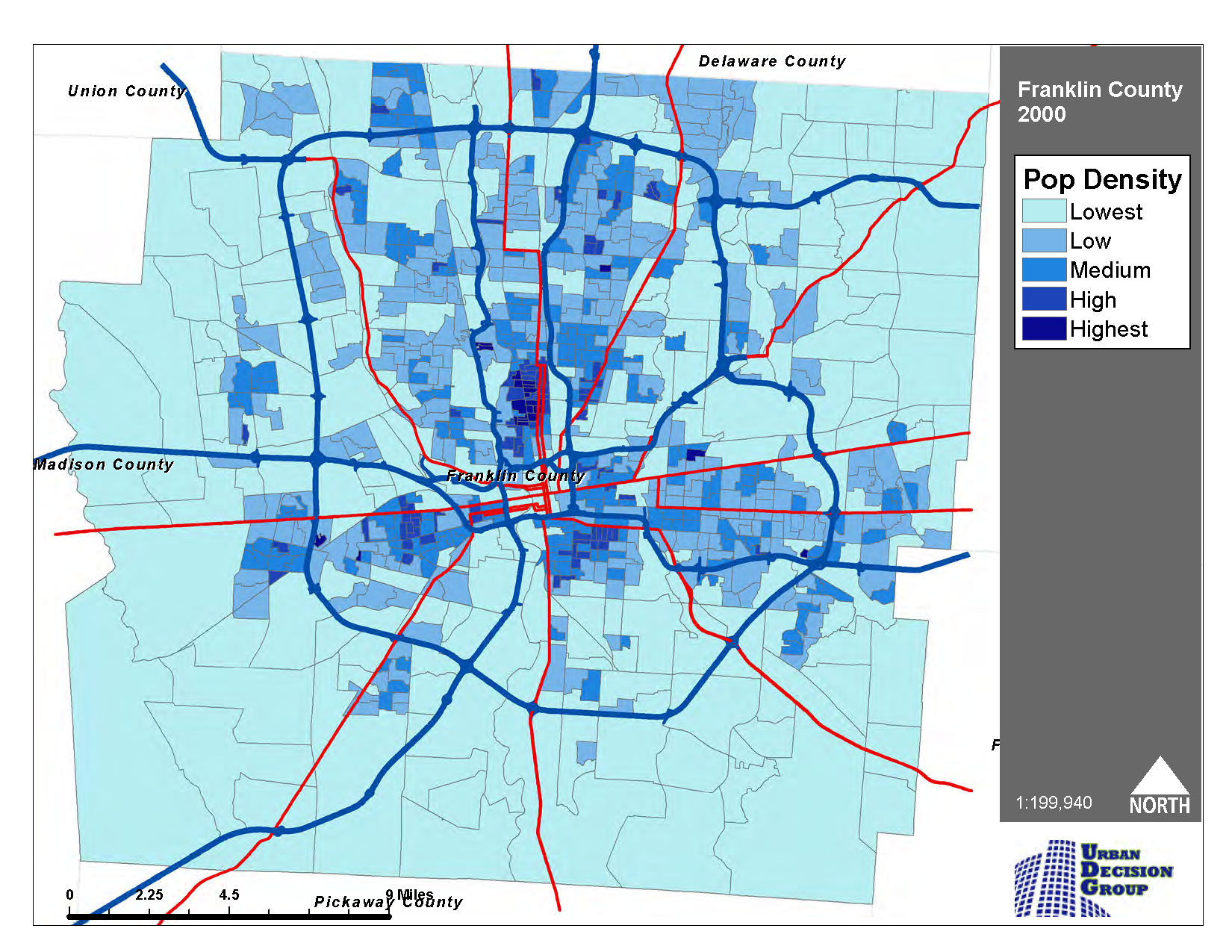
COTA provides decent service to get around in the downtown and directly adjacent neighborhoods, but it drops off sharply as soon as you get outside of that area.
I live just outside the beltway. Driving to the OSU stadium just north of downtown would take me about 25 minutes. According to Google maps, the nearest COTA stop is a 20 minute walk away, then it's an hour and ten minutes to get to the stadium.
Agreed it would be lovely to be able to hop on a bus or train and get somewhere within a reasonable amount of time.
I live in Berlin and strongly prefer the bike over the bus because buses are slow and unreliable. I wish we had a lot more bus lanes and aggressively towed cars blocking them. More subways would be even better though.
When I was in Mexico City I was blown away and inspired that their bus lanes were actually physically separate from car traffic, sometimes they were even elevated a foot or so alongside car traffic. It made the buses so much faster! I wish bus and bike lanes in the USA were equally separated from car traffic. Different color paint and intermittent bollards don't cut it.
If something is worth doing, it's worth doing right and physically separate bus lanes is doing it right.
Bus lanes are usually not a budget problem. The problem is car centric laws and regulations that make it hard to impossible to take space away from cars.
Nonsense. The infrastructure in much of the US is already there. All you need is willingness to enforce it. All you need maybe is a bit of paint. Police could actually make some money.
I know I'm a corner case on this, but there are two cases where our car life significantly improves your quality of life.
1: you live with ADHD: "Oh my God, I need to leave five minutes ago" scheduling method. To anyone who says, "You just need to be more disciplined about time," I refer you to the part about ADHD.
2: If your quality of life depends on activities that are more wilderness/far away from cities, such as hiking, astronomy, camping, bird watching, and don't include (actively exclude?) urban experiences that require amenities.
3: Friends and family live 30 minutes to 6 hours away.
I have no problem with improving bus service for people and getting them out of cars because that means there'll be more room for me to go to where I want to go when I want to go.
Half of all dutch people own cars (10,062,194 cars / 17,904,421 people). The majority of people still ride bikes or take public transport to move around except when they need to take their car. For comparison, a majority of americans have a car (259,238,294 cars / 333,287,557 people). Note that the denominator includes children in both cases.
You're not asked to give up going to the wilderness.
Regarding scheduling, in my eyes public transport where the mean time between busses is not under 15 minutes is not public transport. Running after a bus is a signal that the frequency is too low. "I need to leave five minutes ago to take the bus I intended" should be followed by "if I leave now I'll be a few minutes early for the next one".
You are right, I was not asked to give up going to the wilderness; I just want to go to the wilderness of my choosing and not be constrained by someone else's transportation.
Funny thing about scheduling. I have to plan to leave an hour earlier than I need to, and even then, I'm frequently late. Yet, my hyperfocus kicks in when I sit in the car and go through the rituals of "I'm driving now." The vigilance can be exhausting, but usually only bothers me when I'm leaving an observing site at 3 o'clock in the morning or I'm driving at twilight in deer country.
Living with ADHD also increases your chances of getting into a car accident substantially. I can't find the numbers now, but the increase is non-trivial and there are some clear mechanisms (inattention, impulsivity and risk-seeking behaviors).
ADHD is a big part of the reason I don't drive. I'm lucky enough to live in Berkeley which is very walkable with decent transit, and I would hesitate to move anywhere more car-oriented exactly because I have ADHD.
Yeah, ADHD does affect one's ability to drive safely. On the other hand, I've been driving for over 50 years. I've had one accident that I was responsible for. Various other vehicles have been involved in five other accidents where the other driver backed into my parked car.
I think the reason I've been hypervigilant about safe driving practices is that my father owned a rigging company, and I was driving forklifts and stake trucks in the yard from about 13. I understood the impact a vehicle could have on other things, people included. Living in that world from about age nine on teaches you to be obsessive about properly securing a load (Molding machines, air handling units, lathes, etc.).
I've often thought people would be better drivers if they started their driving experience with the motorcycle safety training course curriculum and drove for a year on motorized two wheels, taking up the lane and keeping up with traffic.
When I was younger I was lucky enough to live somewhere rural where I got into a couple of single car accidents that I walked away from. Now my ADHD hyper focus is super attentive when driving.
1: This "ADHD" issue is because you've never seen properly ran bus system. I used to live in big European city, riding bus to work everyday, and I never even knew the bus schedule. I did not have to. They would come every 15 minutes, or every 7-8 minutes during the rush hour. So I could just show up at the stop anytime and be sure that a bus will appear quite soon. Zero advance planning required.
The ADHD issue is because I always think I can get more done in the time before I need to leave, and I end up hyper-focusing and missing the leave time. Another ADHD factor is that if I don't sit and watch every stop go by, I am likely to miss it because I'm reading and not paying attention. This is not a problem when driving.
Thus you get more done when using public transport. Nowadays with phones and portables you can even read your email and work rather than justb read the newspaper as commuterts did 20 years ago.
Yes, and that's a good thing. Because if I'm on transit and I read, I miss stops, sometimes as many as four or five. Then my day is really fucked. I literally have to sit there and count off every single stop. With driving, I don't have that problem. I have internal mapping and external GPS to remind me what I need to do next.
As for getting work done, back when I was an employee and using transit, two factors kept me from doing work on the transit system. First, my employer already got enough uncompensated labor from me. I wasn't going to give them any more. Second, I use speech recognition, and dictating company confidential information in a public setting is unwise at best.
2. This is why non-car-centric countries don't ban cars. If you're that kind of person (and not everybody is), you buy a car. You may not use it beyond these wilderness activities though.
Good points. A few years ago, I visited a friend in Estonia, and even though he was in Tartu proper, they still drove almost everywhere. Essentials were only available by car.
Trains are an interesting subject. For them to be useful, you would need to have rails covering the same destinations and paths as the highway system. One should also be aware of network effects when adding another layer of transportation services, including how they affect the distribution of services and residences. From experience, we know that roadways encourage spread because they allow you to cover a greater area with little time cost. Rail will likely encourage denser development and a higher cost of living due to a greater influence of rent-seeking entities.
One of the tensions one would need to explore is the tension between the need/desire of a chunk of the population to keep their distance, keep their living space separate from others, and be acoustically and physically isolated from them, while still needing services a 30-minute drive away.
> For them to be useful, you would need to have rails covering the same destinations and paths as the highway system.
Its funny to me that you suggest that trains need to cover what they highway system covers. When of course trains existed first and already covered many more places then highway system ever covered in most places. And with buses countries got the opportunity to cover things away from train-station and that was really not all that expensive even in rural areas.
Its just that in some countries, many of these trains were removed and the countries focused all their finances on new highway systems. And often demolished large part of productive cities to achieve it. For more so then trains ever did.
> Rail will likely encourage denser development and a higher cost of living due to a greater influence of rent-seeking entities.
No actually when you do it properly, then rail makes it so you can have a dense core around each station where you have everything you need locally while also having access to a city center in a short time.
While you subburb example misses that all subburbs are massively subsidized and make negative money. Its the poor people in the cities that are paying extra to finance these subburbs. Urban3 has done tons of analysis of this. The subburbs are the rent seekers, you just don't think of them that way because you see it as 'normal'.
There are plenty of examples, for example how in the 60s Sweden used subway trains to build massive amounts of housing alone those new lines.
> between the need/desire of a chunk of the population to keep their distance
You can have that, but you will find that once you properly account for the cost, people are much less willing to spend that money. That's why before extensive zoning codes, minimum lot sizes as requirements, parking minimum, free street parking, free highways people lived closer together. And of course the massive federal top down intensive given subburban development Post-WW2, along with the redlining of cities. All these are hidden cost on society that you simply hide and put on county, state and federal taxes.
I'm not a fan of busses and use em only by necessity. Otherwise I prefer trams and bicycles much more. Trams are more chill due to less hard turns and more space, bicycles are a beast for fast arrival if infra is ok. In Zurich trams are very nice, but bike infra comsi comsa up to bad depending on area.
Trams have the same problem trains have. If something happens on a tram line (and these are a lot more integrated with roads than train lines, so things do happen), a big segment of the network comes to a standstill. They're not like buses or cars that can drive around a major accident in an emergency, even if that meanns they'll skip a stop or two.
My experience of public transport modes in various cities is at odds with this.
Trams and trains generally offer far more reliable schedules, frequencies and journey times than busses because they either have completely dedicated alignments or have priority where there is any interface with normal traffic.
Most buses inevitably bunch (see https://setosa.io/bus/ for a nice simulation) and/or get stuck in traffic as a matter of routine. The inconvenience may be less per delay but busses are delayed far more frequently than trams and trains on most of the public transport systems I've used. So for regular users, the cumulative inconvenience is much worse on busses than on trains/trams. Which is why people flock to trains and trams when available as an alternative to busses.
Specifically with regard to the parent, the frequency at which unplanned outages happens with tram services in Zurich is extremely low in my experience - certainly planned changes to schedules or routes (for maintenance, upgrades, etc.) are far more frequent. And when "something happens" (i.e. a traffic accident), the path for trams is cleared as quickly as possible - often in 30 minutes or less - so you'd really have to be unlucky to be inconvenienced by such an occurrence.
lol i was recently in such a situation - tram collision with a car. I got off and decided to walk to the central station... to find out that the tram was near me since they probably recorded everything they needed and it went to the depo...
In most situations you want trams to have own lanes and semaphore priority which reduces collision chances to a minimum. Worst case you can have some spare busses to provide temporary replacement services for such situations or you can divert some buses from other lines to provide services in problematic sector till situation isn't resolved.
> A single bus carries on average 20 times the people cars occupying the same space would (as you rarely get more than 1 person per car in peak hours).
Some animated GIFs illustrating how much space automobiles take up compared to alternatives:
The reason why US bus ridership is so low is because buses are terrible. They are dirty, loud, inconvenient to get onto, often badly designed inside (too many seats, too little space), with unsavory individuals making you feel unsafe. In summer they aren't air conditioned, they seem to be refrigerated, you literally need a coat to stay warm. The fact that they are also slow is just icing on the cake.
In addition to that, the US has a stigma: "only poor people ride buses".
I sometimes take a peak into European busses but I don't see 25-30 people sitting in there on average. That is a lot of people.
Busses, at least the one where I live in Europe, are very loud, noisy and smelly. I'd rather have 20 cars pass my home than one bus. I don't hear or feel those cars but once that bus passes my coffee cup visibly shakes. I also don't mind cycling behind most cars but cycling behind a bus is a terrible experience. You feel the heat blasting out of the rear-right side and the diesel smoke is terrible.
Busess are improving many of them are now fully electric.
20% of London's busses are zero emission - agree that London is dense enough for this to work - long didtance busses still have to be diesel, although Tfl have some 15 mile routes that are electric
As an European I really _do_ mind buses. I try to avoid riding them as much as possible. They are dirty, smelly, and really cramped with little legroom. I would really hate living somewhere where I was forced to use them, and would rather move elsewhere.


A single bus carries on average 20 times the people cars occupying the same space would (as you rarely get more than 1 person per car in peak hours).
I'd rather take buses than the car in any city. Cars make cities dangerous, noisy, polluted, congestions make people nervous behind the wheel, fights are far from uncommon. Finding parking, paying for it is another issue, common in Europe where (luckily) city centers are often millenia older than cars.
At no point of me living in the US I found the car-centric model anywhere better.