Lego is one of those companies that is simultaneously amazing and kind of sucks. On one hand the core product is incredible. The tolerances on the bricks are micrometer-level precision and the fact that pieces from the 70s snap perfectly into ones made today is mind blowing.
On the other hand, a lot what the company does today just sucks. Set prices are outrageous. Printed bricks get replaced with stickers and many sets feel like display models than something you can play with. The Mindstorms/NXT line had huge potential but then just sort of fizzled out. And the push towards smartphone-dependent toys feels weird. Who actually wants their kids staring at a phone to play Lego?
It's so sad, because the core product is basically perfect.
Lego was always expensive, you can compare prices adjusted for inflation. For example, the 1979 Galaxy Explorer <https://brickset.com/sets/497-1> was around $32, that's $144 today. The reimagined set from 2023 <https://brickset.com/sets/10497-1> was sold at $99, $106 today. Not only it is cheaper, but much larger and with many more pieces.
Yes, they have kept up with inflation, and that is the problem. Manufactured goods like Lego bricks should fall in price through innovation in processes, scale, etc. What does raise higher than the average inflation should be be labor-intensive products/services. In other words, it feels much stranger today how expensive Legos are compared to 47 years ago.
Lego is branding, curation and quality bar, though. They're the Apple of bricks (weird sentence).
There's tons of lego-knockoffs and of not even such lesser quality that the difference can be perceived by casual inspection. The set-to-set quality bar is really where it is, especially among their set lines not targeted at children or low-end of market.
But none of those sets have any kind of staying power. There's Expert/Creator/Modular sets from 20 years ago that sell for $500-1000 _opened and pre-built/re-disassembled_. That's all brand power.
So they're less about $/brick (though i know people scrutinize it) and more about price point and brand. Phrased differently, having your brick company race to the bottom sounds like a losing strategy.
Yeah I don't know what this person is on about. Lego is obviously premium and ... charges premium prices because ... they're a business. People (consumers) who want premium products ... pay the premium.
I would be much more frustrated if they became cheaper and reduced the quality of the product.
There is a prevalent view of economy that insists businesses sell their products at the minimum price they can still make a profit at (but not lower or you are dumping.) A Marxist view of economy, if I must.
Whenever I meet one of these people, I ask if they are willing to negotiate a wage reduction with his HR. My logic is simple. If you think it is wrong for a business to sell a product at the maximum price they can demonstrably get away with like Lego does, then why is it right for you, a professional worker selling your labor, to sell your labor at a price higher than what is necessary for subsistence?
> There is a prevalent view of economy that insists businesses sell their products at the minimum price they can still make a profit at [...] A Marxist view of economy, if I must.
That's actually how competition is supposed to work in capitalism. If you sell your products at much higher than the minimum price, someone else can make a profit by selling slightly cheaper and taking over your market share.
That's contingent on the competition offering a similar experience and quality, at a smaller price point. As a parent comment pointed out, no LEGO knockoff has been able to provide the same experience as LEGO.
I think what the commenter is getting at is that it's not even about competition. People get mad when companies charge more than is necessary to make what they deem a reasonable profit.
Of course, as you mention, in capitalism, a competitor is free to go in and undercut the leading brand, but they have to be able to sell why they're better AND cheaper.
Interestingly that's one of the Marxist critiques. The market simply is not efficient enough to work fully. The effort to get Lego2 off the ground is simply too high and Lego gets an effective monopoly in their market segment (premium blocks).
If Lego was nationalized then the excess earnings that go into the owners' pockets as dividends or asset value would be realized by the people. But that of course leads to different inefficiencies (investors don't invest, etc...).
imo it's not just that other brands are of similar quality but often of way higher quality than lego. you get so much more for less money from other brands, while lego sets are becoming kind of a joke. using stickers everywhere and randomly colored bricks on the internal sides of the set
Prices are constrained by demand moreso than by cost of production. Lego pieces are expensive because they can be, they still sell, and this is largely due to the quality. As long as the quality moat persists, they can charge as much as people will pay, and--good for them!
That you personally would prefer lower prices does not mean they "should" be lower. Those lower costs of production, to Lego company, "should" mean higher profits, not lower prices, and again--good for them!
The risk Lego faces is that they don't actually have a quality moat any longer. You can get non-lego sets with no stickers, plenty of prints, LED lighting, at a cheaper price, and with the exact same piece quality. I purchased this set: https://www.lumibricks.com/collections/steampunk-world/produ... over Christmas, and I paid $105 because it was on sale. The pieces were indistinguishable from Lego in quality, and the lights and lack of stickers was a quality increase from what Lego offers.
What moat Lego has is: brand recognition and licenses. Which aren't nothing, but don't offer much protection.
Not disagreeing with you, but at least when I hear "lego knockoff" I think of the shitty ones, because I've never seen a Lego knockoff that wasn't shitty.
Lumibricks seems like a promising brand, but I've never heard of them, possibly because they don't spend as much on marketing as lego. And if they did spend more in order to compete with Lego, they might need to increase price!
> but I've never heard of them, possibly because they don't spend as much on marketing as lego
It’s a newer brand—they changed their name to it some time last year. But they seemed to spend a lot on advertising last Christmas—at least on YouTube, it seemed like tons of reviewers were talking about their sets. That’s how I found out about them, at any rate. And I’ll say—the one I got came together nicely, and looks great. The tons of lights are just, really neat.
> when I hear "lego knockoff" I think of the shitty ones, because I've never seen a Lego knockoff that wasn't shitty.
The cheap-o ones you get like at the dollar store, absolutely. But Chinese manufacturers have been making good quality knockoffs for a while. A decade at least? I bought my first knock-off technic set around 10 years ago, and it was 90% the quality of Lego at 25% the price. But the quality has only gotten better since, and is now totally on par with Lego. Admittedly, the price has gone up, too.
Interesting. Gotta check those out! Not that my family needs more LEGO... The remains of our Millennium Falcon after my nieces came over glare at me everytime I look at a new LEGO set.
I don't want to sound like a shill, because I don't know them at all, and I still spend enough money on actual Lego. But I am really happy with it. Pieces were great, quality was great, I love the lights, I hate Lego's stickers. And the piece count was 2x or 2.5x what I'd get from Lego at the same price. And I love steampunk, and Lego doesn't have a steampunk line. I'll absolutely buy more from them, so (for me at least) their big Youtuber push last year worked.
No but I appreciate your recommendation. I find that product recommendation on HN tend to be higher quality and/or more relevant to me than generic lists (I added so many books and games to my backlog from HN comments because many HNers have really good taste).
Maybe I'm saying the quiet part out loud. I hope no one tries to advertise on HN after this.
A reputation moat is still a moat. It seems to me that Lego prices will drop as soon as they are forced to by competition, and not before, and this is fine.
It is, absolutely, but it’s a lot more shallow a moat than having a product quality moat.
> Lego prices will drop as soon as they are forced to by competition, and not before, and this is fine.
I agree, they’ll survive quite well. But the large profit margin they’ve grown accustomed to might disappear, and that probably doesn’t bode well for their management.
And heck, maybe they’ll stop shipping stickers on expensive sets, too. That would be nice.
I've seen enough reviews of recent Lego sets to doubt this. Sets with a brick or two where the color is off, sets where the final model falls apart if you look at it wrong, and when there's fan designed alternatives which are more solid and better looking it's clear it wasn't a physical limitation.
Not to mention sets that indeed just feel like a ripoff, like the pyramid of giza which costs $130 and is actually just half of a pyramid, but the backside of the model has slots that let you connect it with another half if you buy two of them. And they even admit in the marketing it's an incomplete product with "Complete the pyramid - This model comes with clear instructions and can be connected to a second model (sold separately) to create a full pyramid", of course only visible after scrolling or looking at more product pictures.
They are. I should have added that Lego’s designers are a bit better still. You can get botanical sets from a lot of manufacturers, but the Lego ones are just nicer.
Anything that has only kept up with inflation over the last 50 years is cheaper today than it was 50 years ago relative to people's incomes, which is the relevant definition of "cheaper".
Not sure exactly how Lego prices have evolved but, as others have said, Lego is a brand and is unique. Their sale prices have little to do with their costs.
For most people anything that has only kept up with inflation over the last 50 years is more expense today than it was 50 years ago because wages have stagnated while prices have soared.
For instance, the median household income in the United States in 1976 was $12,686. That's $72,857.55 today based on inflation (Google/Census Bureau Data + online inflation calculator).
However, Google's AI overview says "As of early 2026, the median household income in the United States is estimated to be approximately $84,000."
So the the median household income in the US today is about $11,000 ahead of inflation since 1976. People in the US are richer now that they were then.
I remember reading in a personal finance book, it's not about what you earn, it's about what you keep. I think the concept applies here too, even if the context is slightly different.
Ok, but, what about median household size? Shouldn't we calculate the "richness" based not on how much each household makes but how much each member of a household gets from it? My guess is that households are smaller these days, but don't know.
I'd be curious to know if in '76, most households were dual income or single. My intuition is that many families could afford to have a parent stay at home with the kids back then.
Additionally, let's not ignore the fact that housing appears to have gotten more expensive disproportionately to income rising. And if two parents are working they often have to pay $1000+ for daycare
Most replies don't like my comment because it hurts the narrative that people want to believe even after I quoted hard data. Especially since the 70s in the US were rife with economic and social issues. Very interesting how the mind works.
I wouldn't say people didn't like your comment. You don't seem to have been downvoted as far as I can tell. You did cite hard data but multiple other commenters explained why the data you provided doesn't tell the whole story. Just because people disagree with you doesn't mean they don't like your comment. They're just trying to understand more.
It has almost 4 times the number of pieces, but is only about 50% longer and wider - there's just way more smaller pieces. Price per piece is very misleading when comparing older and newer sets. The newer ones have more details, look slicker, but have a lot less "meat". Which is not that great for creative play.
I bought a set recently which was definitely padding its piece counts. The interior structure of a solid shape was constructed out of dozens of small 1x2s and could easily have been a handful of much larger pieces with no downside. I didn't consider the "more pieces = more perceived value" logic until this comment.
For a while the complaint was that Lego was making too many big, specialized pieces, so I'm amused that the current complaint seems to be that they're using too many small generic ones.
I had a weird build recently with the Luxo Jr model. There are a couple of cavities in the model that are partially filled in with very small parts. These parts don't connect in a way that makes then structural. I'm still puzzled why these parts are there.
I always charitably assumed that they designed models to utilize surplus pieces for the internal structures, pieces that might be hard to use elsewhere.
They may do that (designers have a "part budget" they can spend in various ways) but the real reason for weird colors inside models is to make it easier to build; especially since many of the models consist entirely of various shades of grey and black.
Various piece size also makes it easier to see if you got the wrong piece.
Definitely agree on the reduced usefulness for creative play. My kids got a lot of Lego sets as gifts when they were younger. Which is great, I love them playing with Legos. But once they're done with the instructions that's just kinda it. A Star Wars or Frozen or Minecraft themed kit ends up being all weird one-off specialty pieces. They are necessary to make an extremely detailed replica of the Millenium Falcon. But they have no place if you just want to grab a handful of bricks and start building whatever your imagination comes up with. We have a tub full of thousands of pieces and it never gets used. I think it's a bummer that they've pivoted to pushing these intricate $120 kits to adults rather than designs featuring more reusable components. You need to go out of your way to buy tranches of generic bricks if you want to have free play.
The Creator 3-in-1 sets are basically what you're looking for, they just don't get advertised much. A lot of them are more generified and rebuildable, sometimes even more refined versions of more expensive sets or parts of more expensive sets. Maybe the most obvious are the 3-in-1 dragon and dinosaur sets, which to me feel obviously like more generic reworks of D&D and Jurassic Park builds respectively, and have a lot more in the way of generic tiles and bricks than the licensed sets they're derived from.
A 50% increase in dimensions doesn't directly transform in a 50% increase in volume.
>The newer ones have more details, look slicker, but have a lot less "meat"
I presume that the 2022 model has as target audience nostalgic adults, but otherwise I agree, the new sets seem far more fragile then the ones released a decade ago. I think this is due to a recent focus towards adults from LEGO.
It's the other way around - because pieces cost roughly based on their size (amount of material) modern Lego sets are "denser" and heavier on average than similar sized sets of the past, because as piece count (and detail) goes up, piece size has been going down.
The discussion is about price, not cost. Lego is keeping the price per piece somewhat stable because they know people look at that, but as pieces get smaller (and thus cost less to make), their margins go up, and sets get smaller for the same price.
I have the re-release secondhand unopened and I think I paid about that much, so even in a collector's market, not terrible at all. An expensive toy to be sure but a deeply satisfying experience if you like that kind of thing.
Buying buckets of used bricks is pretty cheap, too. I bought an adult's old lifetime collection for $30 CAD. My 2 year old son and I are still sorting them.
Sorting Lego is such a pain in the ass. I have like a huge stash from when I was a kid. Back then we just had it all in a few tubs and dug to find a part. But somehow now I feel I must sort them… but the “right way” is ill defined and kind of sucks the joy out of playing (especially disassembling)
And there is no “right way” that I’ve even found. Sort by color and now the little pieces fall to the bottom and are hard to dig for. The best I can see is part type and size… maybe… even then it sucks out the fun. I want to build cool shit with my daughter not spend every moment of Lego time sorting. There is no joy in sorting…
Maybe I just revert back to the “big tub” approach.
I dunno. Thanks for listening to my TED talk I guess.
Yeah go for it! I'll add a comment though, now we are working on automated shifting bins with stacks of different size grids to filter the littles to the bottom and still easily pick up the top bigs to see them. There was been a discussion (by my children) about something involving a Lego vacuum they saw online.
Why sort by color if human eyes (unless colorblind) are great at recognizing different colors? Back when I was a kid, I used the big tub approach (with the Spyrius base octant as my shovel).
Build with what pieces you can find, rather than plan the perfect structure ahead. Improvising keeps the creativity going! Wheres fun if sorting legos sucks all the Joy from it
> Build with what pieces you can find, rather than plan the perfect structure ahead. Improvising keeps the creativity going!
That's a valid perspective. It can be a lot of fun to dig through the bricks and build freely, letting things take shape.
But it's also valid to have a design phase, where designs are crafted (perhaps even very precisely) and to enjoy that part -- perhaps even using some manner of LEGO-oriented CAD. (Or SolidWorks; I won't judge.)
And then: It's OK to find pleasure in following a plan to build a tangible thing in reality. This concept is strongly reinforced by the fact that LEGO sets come with instructions that are organized into simple steps.
One of the joys of LEGO is that it's very inclusively all fine.
I feel like I’ve seen essentially this same comment every time a Lego thread comes up but there doesn’t seem to be unanimous agreement on which brick toys are better. Sure, some people have good experiences with brand X but others will say they’ve had bad luck with the construction. Someone else will talk up Brand Y and someone else will point out how terrible the instructions are. Are there any brands that actually do consistently deliver a Lego-quality experience without the Lego price?
I guess it depends on what a "Lego-quality experience" means to you.
I grew up with the mid 80s to mid 90s kits, mostly castles and pirate ships, a few space sets. I think it's a very different experience compared to the nightmares I read about building the Mould King Eclipse-class Star Destroyer ( https://www.reddit.com/r/lepin/comments/1pdfx5y/mould_king_e... ). The concept of "bad luck with construction" is foreign to me, because most of the kits I remember building as a child were comparatively simple.
I'm working on this house with my 5yo daughter now: ( https://ja.aliexpress.com/item/1005006068361257.html ). Costs ~$20, we work on it about 30-45 minutes several times a week, so it takes months to finish. If she tears it apart 6 months from now to build something from her imagination, mission accomplished.
I hear people rave about this Cyberpunk-style kit, maybe this is closer to what you expect? https://mp.weixin.qq.com/s/_a_a4b2bvISsP6pyjkSxLw (Chinese language review) I plan to buy it at some point....for myself, not for my kids!
If you want to spend some time looking at critiques from someone with experience, I find JANG's Youtube reviews of both LEGO and non-LEGO brick toys to be well-balanced. We have differing opinions, but he has decent rationales for most of his opinions.
Lumibricks is fantastic, built in lighting (or rather you build it in as part of the model) and as someone who has always turned their nose up at off brand Lego, the parts are definitely 99% of the way there. Instructions the same quality, if not better, than Lego as well - all for about the third of the price.
Minifigs are terrible but I have hundreds of those spare anyway!
Lego is some kind of cultural icon now, and many people want to participate. That's why they have tons of sets aimed at adults over many themes, like plastic flowers, formula 1 helmets, old video game consoles.
Many of them are a really bad and expensive purchase if you only care about the theme itself, like the latest Death Star (or almost any Lego Star Wars set). You can usually buy a similar and cheaper non-lego model. Or the Titanic set too.
I've since bought her a 3-floor hospital, a firehouse, a pink villa with pool, and about 2 dozen doctor and engineer minifigs for the same ~$120 outlay. Only disappointment is the legs on the Chinese minifigs, they are difficult to seat properly on studs because the legs are at a slight angle (almost like manspreading).
I have to stop myself from going on a spending spree on AliExpress, I might order an entire Age of Sail LEGO navy.
I don’t know enough about plastics, and if it’s ABS it’s ABS, but how is it dyed? Point is I don’t know, so I buy from a company that has a reputation and would be held accountable, and would never buy kids toys from a fly by night business with no reason to care how carcinogenic their product ends up being
Nostalgia... Lego was amazing decades ago so we want it to remain so. It's not anymore though. The whole raison d'etre, namely infinitely recomposable bricks to be creative, was lost the moment they realized they were a LOT more money in custom sets. Sets become collectible, perishable, trends can form, secondary markets exists, etc. It's simply about the baseline, not the principle. Sorry.
The existence of specialty sets doesn’t subtract from creating building.
My kids get some of the specialty sets, build them, then hours later they’re either taken apart or heavily modified.
The specialty sets can provide some interesting unique pieces too. My kids have a photographic memory of each of those special pieces and which set they came from. They’ll remember them and search until they find that exact piece.
> Sets become collectible, perishable, trends can form, secondary markets exists, etc. It's simply about the baseline, not the principle. Sorry.
I don’t know what this is supposed to mean, but you can completely ignore secondary markets and collector sets if you want.
There are more sets and pieces than ever. You don’t have to collect anything.
> My kids have a photographic memory of each of those special pieces and which set they came from. They’ll remember them and search until they find that exact piece
I had the same skill (still do). Imagine following the instructions the first time. A part you're encountering for the first time stimulates the memory. I knew my collection like a dragon's hoard. For instance, I owned twelve white 1x2 tiles, all from Coast Guard Station, so that was the limiting piece when building tiny space-fighters...
> My kids have a photographic memory of each of those special pieces and which set they came from.
Read the whole sentence- this is clearly an informal use of 'photographic memory' to indicate that his kids are really into Lego and keep track of details in the way only kids can.
I didn't see him making any generalized claim. I recall the things I'm really into better than I do things I'm not, which is all I think he was saying about his kids. (My four year old remembers facts about volcanos - including the name of the scientist who made the claim - waaay better than he does where he left his shoes, so it tracks for me!)
The point is: when I was a kid, all Lego sets consisted almost completely of general bricks. You could, and would, start building different things from the moment you got your first set, and the possibilities would increase exponentially once you got a few more sets. Any set contributed to your collection of building blocks to create new things.
I really don't get this sentiment. The only sets that I think didn't contribute like this were the bionicle stuff. Getting a few more unique parts with a set gives you more options, not less.
I think you have the same feeling I have with most modern sets (and especially technic ones): not blocky enough and too much smooth curved surfaces. But you can still make blocky stuffs if you want to, while being able to learn modern lego building methods and integrate those curved designs in your builds.
I don’t think this is true at all. What do you mean by “general bricks”? If anything there is more brick-built stuff nowadays.
For example the Creator 3-in-1 Castle (which I got for my son for Christmas) is pretty similar to castle sets I had as a child but basically way better and with brick built horses rather than large mould ones
The 3-in-1 sets (where the set numbers actually begin with 31) should really be the first thing you look at when choosing a set for a child, and they deserve more praise. There are a lot of cool 3-in-1 sets out there. That castle (31168) is really good (and those horses are too!), and the haunted mansion (31167) is just cool with minifigs which are a hit with any kid.
For a small and cheap present that hamster (31376) is just too cute to pass up too.
It feels like those sets are where the Lego designers get to do their thing and do it right, without the weight of licenced IP (of which there is so much) and the trite offerings of the City range.
Other ones that to me felt like completely fair value and better than anything I had as a child were the Creator Bunny, Space Telescope, and Space Robot. Something like £18/£25/£25 the second two having light bricks included.
JK Brickworks has an alt build for the bunny that doesn’t require a massive amount of different pieces and makes it lay mini eggs.
Lego sets aimed at children are still good! They work as standalone toys, and can also be reassembled, modified and combined. Very few toys are like this.
Adults collect them, true, but there are whole lines dedicated to them.
The "Creator" sets in particular I feel harken the most to the company's roots. They usually have a few different builds per set and include all sorts of unique pieces for making your own creations. They also usually have very fun designs.
I recently built the NES and Game Boy sets and thought both of those were really great. The NES is probably not priced for most people (we try to stay under 10¢ a brick), but the level of detail, whimsy, and mechanics are all really well done. There are hidden scenes and Easter eggs built into the system that are revealed as you build rather than highlighted as features on the box. I was genuinely surprised and had a lot of fun sharing that with my family as we realized what was coming together.
The Game Boy was much more affordable. Less whimsical, but brought back memories of taking apart electronics and marveling at what these circuit boards and components could possibly be doing.
The Game Boy is apparently one of the best sets of 2025, cleverly built and a nice display item. Still, it is for adults, kids have tons of other sets to choose from.
I often look at these and think they’d be fun for me to display, then think I’d prefer an actual Game Boy disassembled as a piece of wall art [0]. This sort of stuff is just so cool in my opinion.
Edit: now that I look on EBay building my own display like that would probably cost maybe $60 vs $189? Broken Game Boys are $40 on eBay, so maybe a project I could do for fun!
My kids got a Minecraft set and just use the Warden as a toy and build with all the other bricks and a mat to put the poor lego characters in bad situations where they’ve woken the Warden up (he’s a strong enemy in Minecraft)
It was kinda funny to see the Lego Movie, which puts a bunch of emphasis on breaking the rules and mixing and matching everything, and then seeing them release the sets for the movie. I mean, it makes perfect sense. But it was still kinda lowkey humorous. But imo they're still a great toy; very fun to go to conventions and the like, where people just have giant piles of loose pieces you can buy by weight.
Lego is still amazing and you don't have to buy expensive sets for your kids to enjoy them. My son loves Legos and if he gets a set for his birthday it doesn't last long before he takes it apart and starts building other stuff with it.
This is one of those instances where it feels like people are terminally online. Or like the meme of the guy standing in the corner while everyone else is having fun at the party. You can find Legos being given away in a local buy-nothing group. It's still just as magical for kids as it ever was. These complaints are only from an adult who doesn't play with Legos. Who cares if sets become collectibles? Get other sets and have fun with Legos. These are toys that are meant to be played with. Play with them.
They still sell the sets of generic bricks. At that point it is up to the individual customer to buy them if he prefers that. I could see your point if they stopped selling the more free form product, but they haven't.
How can you go bankrupt with Lego? That's almost like going bankrupt with Coca Cola. It's probably one of the most if not the most recognizable toy brand there is. I'll have to read up on this, sounds like a fantastic voyage of mismanagement, if true.
It was in one of those Netflix documentaries - I didn't realise it at the time but there was an 18 month period from 2003 to 2004 during which no new Harry Potter or Star Wars movies came out so sales of the licensed IP sets was down.
Is it episode 7 of "The Toys That Made Us" (May 2018)?
If so that'd make a lot of sense, same thing for Google where founders hated advertising but when it was either going under or getting rich by doing the 1 thing they didn't to go, they chose wealth.
There's nothing stopping you from buying the basic sets and only the basic sets. They didn't stop making basic sets, unless you're objecting to the new colors that go beyond blue red yellow and black?
Some of the classic 80s themes, like Space and Castle, primarily used regular bricks of reasonable sizes in a very limited palette of colours, with a few special parts unique to the theme. They were much more suited to taking apart and building your own creations.
These days, there's just too many specialised and small parts, and too many colours. Even if you buy a big grey Star Wars set, you'll find that the internal structure is often brightly coloured to make the instructions clearer - but this isn't ideal if you want to take it apart and build something else.
If you like City, Lego has you covered, even now (cue the old jokes about Lego City having 500 police stations, 400 fire stations, 20 gas stations, and no shops and no houses).
The other themes of old have been replaced by movie tie-ins, and it's hard to build a pirate world out of Pirates of the Caribbean sets
You can also only get so creative with lego. At the end of the day roblox/minecraft and video games trains kids to build more "relevant" things. Apart from tactility, I don't see what technic/mindstorm offers over digital.
You use your imagination. I had a tub of random parts from a bunch of old 80s and 90s sets that were since put into the blender that is a family of small children. I would build space craft. Big freighters with internal bays to hold smaller ships. Huge bases and compounds for my other toys. Various other vehicles and structures. I was basically constantly building for 10 straight years of my life. No sets. No plans. No eye strain from screens. Just pure creativity and imagination.
My point is lego has ceiling on imagination. Different in analogue world where most of building was physical. I grew up with buckets of mismatched lego and lots of technic sets, it was more interactive relative to other toys at the time, but now snapping bricks vs running server for minecraft city seems like baby mode.
And that is the thing about raising a kid these days. Those damn machines have replaced so much… because yeah Minecraft is like a souped up version of Lego where in creative mode you have every part you need. And you don’t have to dig for it or anything. And it has survival mode and a whole huge thing on top of that.
It’s so difficult to know the boundaries. People from older generations giving advice about screen time and stuff simply don’t understand… “screen time” for me growing up was broadcast tv and a limited set of video games. If you didnt like what was on tv, too bad. Do something else. If you were bored of whatever Nintendo game you had… too bad, do something else. But now… you can get literally anything. Plus the iPad gets used to make videos of playing with the cat, or she will have tea parties with her stuffies and make them tea using some weird cooking game. Etc.
No previous generation had to face this. It’s an order of magnitude or more shifted from when they raised us. Tablets basically can replace almost every single toy from growing up besides ones that require being physical (rc cars, bricks, digging in the yard)… but books, cameras, light brights, etc… all replaced.
It’s completely uncharted water us parents are facing. Anybody that claims to “know the right rules” for tablets and technology is lying to you. They don’t. Nobody does. All we can do is use our best judgement and try to give ourselves credit for doing the best we can.
Good thing with analogue toys like legos is you know your kid is playing with legos that is wiring X brain cells for Y skills, even if Y skills are deprecated in digital world. It's hard to say with current gen, there's screen time to try to shape behavior, there are occasional kids who are tech literate maestros which every generation has, but plenty of kids who rely on LLMs, can only finger type because they grew up with touch screens. We're in tech timeline where passive users, i.e. most kids are impressed by millennials who can write cursive and touch type, other kids build stuff that previously required teams of 100s of engineers.
Without a tangible feedback you won't get any digital skills for spatial memory and coordination, peiod.
And the kids you mention can barely understand files, filesystems and don't even mention them about O(n) notation. If any, these kids doing the jobs of 1000s of engineers are proportionally worse than the average secretary skills in the 80's.
Plenty of tangible feedback on screen, just not tactile. I'm bucketing 2 types, the maestros who have deep understanding and the ones who don't bother. The former are the otherwise top 1% talent who are better off playing with with LLMs/comptuers where ceiling is high vs lego. The latter are being distracted that yeah their personal skills worse than past, but fake floor is also raised so much that functionally they can fake junior work, they just lack critical skills to get past.
It's a little out of date, but the conclusions are still relevant.
Main things of note: Brickheads are pretty economical as a "parts pack." No significant correlation between per-piece pricing and IP licensing (except for Star Wars). Star Wars and City sets are overpriced.
As a kid I loved the giant boat hull piece because it was sealed and actually floated. This in combination with some larger pylon-type pieces from the Star Wars set meant you could build floating cities and vehicles and such and mess with them in the kitchen sink.
Lego suffers from a fandom problem among adults: They have strong nostalgia for how it was when they were kids and they think everything since then is against the natural order of Lego.
The best way to enjoy Lego is to give it to some kids and watch them get creative with it. Unlike all of the Internet complaints, kids have no problem having fun with Lego and being creative in their own ways.
The decline of technic sets is such a shame. There's so little support for anything but representative models of specific cars, despite the platform being able to support a ton of mechanical creativity.
The disappearance of real metal Meccano is really crazy. I know metal is expensive, but also bulk processing of it has never been cheaper or faster.
It's also a shame because it's really good for mechanical rapid prototyping and you can bend and cut it in a pinch and it stays put. But buying vintage Meccano to abuse like that is expensive and feels like a war crime.
My son inherited (well, we're co-owning it I guess) my Lego, and that includes two sets of Technic aimed at educational use (1030 and 1032) which come with a stack of instructions for fairly simple mechanical models to build — each demonstrating basic mechanical principles like gear reduction and pulleys. Those sets used the 4.5V motors which have all broken down, but we also have the 1990 Technic Control Centre fully working and use those instead. That Control Centre is a simple controller used with 9V motors. It is brilliant for explaining the basic principles of computerised automation.
No app. No Bluetooth. Just wires and a simple controller built to be used and understood by children.
Historically Lego was a construction toy. This is what it was in my youth. These days Lego sell model construction kits - most are constructed once and then the owner plays with the model. This represents a radical and fundamental change. I’m not sure when it happened or how suddenly it happened as there is a large (decades) gap in time since I played with Lego as a kid and my current exposure to Lego via my own kids. Our home is full of Lego models but I don’t recall seeing my kid using his vast amount (compared to the shoe box I used to store my Lego as a kid) of Lego to actually construct something. The “studless” change - with its inside-out building technique makes it virtually impossible to alter a model once built - unlike the old bottom-up approach where it’s trivial to alter. It makes me sad because I remember with nostalgia the hours I spent building all sorts of fanciful constructions with my box of generic Lego pieces but I also acknowledge that model building — which I do with my kids - is also fun. But it’s just not the same play/toy as it was years ago.
Even when I was a kid, I wasn't keen on graphic designs on the pieces. I liked the uniformity of consistently-colored pieces. Most graphics only make sense in the context of the set they were packaged in. Stickers give the customer flexibility. Use them when you build the set, and remove them later if you take the set apart and don't want them anymore.
Killing Mindstorms was a head-scratcher to me. Hell, there was an entire international tournament built around Mindstorms. I know FLL still exists, but why kill that darling specifically?
NXT still kicks ass by the way. I have a backup of the NXT programming environment somewhere, it can be coaxed into running on Windows 11.
You can argue this for their sets targeting children and I don't think anyone minds stickers on those.
On display sets for multiple hundred Euros however it just looks cheap due to different surfaces and colors - especially as no one is ever going to disassemble these sets.
I think that's fair, though I'm sure we would disagree on plenty of edge cases in the definition of a "display-oriented" set.
It just feels to me like AFOLs poopoo on any set for having stickers, without considering the advantages stickers have from the POV from the POV of a child with few LEGOs and fewer dollars.
In my case I think we can agree that the Lego Icons series is mostly display sets I think. At least those are what I was thinking of and that is how Lego markets them as well.
stickers
> just looks cheap due to different surfaces and colors
They are cheap!
To print on a piece you must run the inkjet assembly line, do QC on it.. With early Collectable Minifig series, I heard they outsourced that. I imagine inkjet lines that run all day for one piece type (maybe having changeable jigs.)
It's cheap to print a whole sheet of stickers!
Another approach that isn't so cheap is: in-mold transfer printing sheets. I learned about this at plastics shows around 2000; Apple used it on the all-in-one spotted iMac in 2001-ish.
Now since Lego ships perpetually ships 1x4s and 1x2s with black smileys or such, I guess carbon black in-mold transfer must be cost-effective. (That's a guess)
I know we're gonna be arguing taste in stickers forever.
I have some of those display sets and I think the stickers look fine. Yeah it's less convenient than printed pieces, but I think the complaints are significantly overblown.
Another detail: National Instruments declined to update the Mindstorms software. Just wasn't a profitable business case. (The LabView vi libraries, I dunno if they worked past 2015.. I stopped upgrading.)
I finally had the time to get back into FRC mentoring last year, for just one season. I changed jobs and had to move across the country before this season started. I miss it dearly.
> the push towards smartphone-dependent toys feels weird
I haven't seen this push? The new Lego Smart stuff is explicitly "screen free play". There is an app but it's just for firmware update and configuration and you can't even connect it unless the brick is on the charger.
Which Mario ones are you thinking of? Because for the only ones I know of with electronic character, you just place them over special tiles they can read to select how they will react.
I hate app obsolescence, and licenses that expire on your old hardware (Microsoft Word..) I exhibit 1980s video games. The hardware just continues to work. It's a disgrace what happens to mobile games, they just disappear. (Whattaya do, save all your old phones? I'm hating on you, Atari Classics app on iPad 2; revoked my paid license to use it.)
But to be fair, Lego has gone to great lengths to keep their companion software alive. Still, the nature of mobile: apps require constant updates to stay listed for new OS versions.
For one, Lego Commander existed uselessly on my phone long after it ceased to work... until one iOS it wouldn't install anymore.
Lego giving you a CD with software and instruction was a comfort (challenge: find a CD drive!) but only Mindstorms really.
For desktop apps in the 2010s, Lego relied on Silverlight to get Mac and PC compatibility. So what happens when you rely on a Microsoft framework... still as late as 2015 I was still able to download Mindstorms 2.0 (introduced 2002??) from Lego.
With instructions pdfs, Lego has been ok to let hobbyists reproduce the downloads (last I saw.)
Another thing Lego did was to provide SDKs for Mindstorms (a while after the community reverse-engineered a lot of it...). Opening it up that way was encouraging. (Lego even started distributing HiTechnic's 3rd party sensors, the folks that reverse-engineered the Mindstorms 1.0 RCX.)
I was part of the fan movement from 1998-2001 that hammered on the message for Lego to open things up. What happened is that they hired several of us :)
Oddly enough I found the Duplo line much more fun to play with as our kid went through the blocks years. You could build something substantial with fewer block clicks, there were fewer different types of blocks, they were less fiddly and prone to vanishing into rugs/carpets, etc. Also the proper Legos tended to be sets which makes it very stressful to mix them into a misc bag.
If you want advancements in engineering and plastics for much better prices, see the wonders that Bandai has made with modern Gundam models. A Gundam Aerial HG is under $20, and you end up with a large multicolor model that assembles easily, has minimal mold lines, and needs no glue. And that's one of the intro models
I think this comes from higher tonnage (clamp force) molding machines. Injected plastic exerts force at the mold seam. Pressing the mold open by even a teeny tiny amount is unpalatable. Mold lines also can result where a mold has insertable parts, like sliding rods to form inner holes.
They suck because instead of buying the rights to the bricks they outright stole the design, the packaging and the marketing materials from the original inventor.
And then they sued the pants of everybody that tried to do the same thing to them.
Yes, it was a shame. After Lego lost in court (to Hilary Page's heirs I think by then) I believe they finally atoned for that.
Still, Lego didn't just sell the Kiddicraft brick unmodified. Lego patented the tubes inside, which gave it superior clutch power. (I have a lot of 2x4 bricks with "Pat Pend" molded on them!)
As I've heard it, Ole Kirk Christiansen had seen Hilary Page's brick as a sample from a molding machine vendor. Lego previously made wooden toys (until his son Godtfred allegedly set the factory on fire) and was casting about for what production to invest in for the future.
The Kiddicraft brick was a little rectangular box, no tubes inside. A lot of brick toys came out in the 60s that were little shells with varying clutch power.
I think it's more the consistency of product design than the manufacturing process. Everything around me, especially in the software world, seems to change for no good reason on a frequent basis. Companies change products all the time for reasons other than utility/functionality. A consistent specification over 50+ years is an outlier.
Did you even read the article? No, even just the Title? Nothing is ever impressive I guess. Certainly not a 60 years running manufacturing process where your childhood pieces can be passed down and combined seamlessly with a set you just bought for your kid. So trivial and easy to do guys.
The precision in tolerance over the years is truly breathtaking.
It speaks to Ole Kirk Christiansen's impossible standards: "Even the best is not good enough" (Det Bedste Er Ikke For Godt.) (usually translated "Only the best is good enough.")
Much more strenuous in Danish than the usual quoted translation! but I know some Danish, and most of all that's how Kjeld Kirk Christiansen explained it to an American audience at Brickfest 2003 (IIRC the year).
As I commented elsewhere, it's not 60 years. Sure, the outer dimensions have not changed and are very strict metric Lego Units. [1] But there have been continual improvement that render old and new less than wonderful to use together. You don't really want to mix 70s-early 80s bricks.
Conversely, if you're reselling those old sets, you need to find vintage pieces (though also Lego would use up older pieces and begin to use newer ones in that set)
But bricks from the mature design of the 80s even didn't age so well (clutch too hard, walls can warp), and there have been many improvements to the interior of a brick. All for sound engineering reasons. Thinner walls and internal voids to prevent warp, subtle changes to fine-tune clutch power.
It's a story of continual improvement, but it makes the old bricks seem less wonderful.
Weird thing Lego started to advertise in the 2000s: Lego bricks reach the proper clutch power after 7 insertions! I guess you have to stress-work the new plastic...
[1] I've used a micrometer on pieces of various age and can't get a difference from the outside. Doesn't help that they compress under measuring.
I feel the same... I remember as a kid, being able to get kits of hundreds of just random blocks and variations and just being able to build/play... all the sets today are all custom blocks that just constrain you and often aren't significantly reusable while I'm not sure that I've even seen basic block kits anywhere in decades now.
edit: I know you can get thousands piece brick sets from third parties or random bulk set sales on Amazon... the issue is the random bits are from the current sets mostly with little reuse value, and the bricks sets are from third parties of questionable tolerance compared to real lego. I just want to be able to get a classic 1000-3000 piece set of classic bricks/pieces from Lego proper, even if it's $100-200 total, still way more than 3rd party but maybe not the same margins for Lego as the bespoke sets.
edit2: there are some "Lego Classic" sets that are closer to what I would like to see, this is probably the closest.
But even then, maybe need that many more bricks that are just bricks... again, there are third party sets that are all block variants that are much bigger/cheaper... would just be nice to be able to get more of those without paying an arm and a leg.
Having the same experience. My kids enjoy getting new sets, but most of them are quickly customized or just destroyed to build something completely new. Terrible take in the parent.
I heard your same rant in the 1980s - only small details have changed (not mindstorms then ...) But kids who want to build have always been able to, and most sets mix and match for those kids.
The two options would be that either the perception is unsubstantiated but persists, or there has been a continuous decline for the last 40 years. I'm strongly leaning towards the latter. I also having the same issues in the 00s looking at old sets from the 80s, and looking back now the 00s look much better than what we have today. Obviously not in every way, and not all recent sets were bad. But overall I have the feeling that there's been a steady trend that the bricks got better but the sets got worse
Lego was always very expensive. They have long made weird custom pieces and those sets have sold well - despite not having the long staying ability that the more basic sets have.
Maybe my perception of 00s models is colored by nostalgia, hard to know. But I haven't been alive in the 80s, so my perception of them during the 00s should be pretty uncolored
My recall was that the 90s was pretty awesome, and the 00s fell into BURPS and large pieces and tie-in sets.
But I think most people either agree there was a dark ages where they went almost bankrupt and did some really questionable themes, or the best time was when they were a kid.
The 90s catalogs rocked in a way that no website ever can, though.
Things are different, people want different things today then they did in the 80s. The top lego sets of the 80s were bought by rich parents for their kids. Adults didn't buy lego for themselves.
Today they're bought by rich adults for themselves, who want different things
Meanwhile kids aren't as bored. In the early 90s as a 10 year old I used to watch soap operas with my parents, because there wasn't much more to do at 8pm on a wet december evening. That was evidenced by Coronation street getting 17 million viewers, well over 1 in 4 people in the country.
Today the same program gets 2 million viewers, nearer to 1 in 40.
That's not because it's materially worse, but because there's more things to do.
Lego has the same issue. In the 80s as a kid there was little to do at home, so things like lego, meccano, spirograph took up the time. Today there's a lot more to do.
There's a reason 80s lego sets aren't as popular as they were in the 80s - the actual sets - and it's clearly not the quality (as a lego 80s set is the same today as it was 40 years ago).
In terms of creativity of model options, the Chinese compatibles are stomping them.
You can even get a model of post-explosion Chernobyl. Not to mention all the sci-fi tie in from Star Trek to Warhammer that real Lego hasn't signed contracts for. But if you want an 60cm Gloriana class, there it is.
Plus Technics-ish sets and bulk boxes that aren't 75% special body panels that only fit that specific model, since Technics itself mostly seems to have been downgraded to the automotive brands advertising department.
When you build a knock off set, though, you can tell that the Lego versions have so much more thought put into the actual build process and the stability and functionality of the finished product.
I got my first Lego set in the early 70’s through a Velveeta cheese mail in promotion.
The company almost went out of business in the early 90’s before they discovered movie tie-ins. I believe the quality of play was lost in this transition because the sets became more literal and less open ended. My first big set was a fire station which certainly literal but somehow seems more open ended then the movie tie/in sets.
I'm not a Lego nerd, but I recently saw a really sweet Lego DeLorean in Walmart priced at almost $200. Now that I have disposable income, I would have impulse-purchased that thing so hard if it would have been closer to $100. But I can't quite bring myself to part with a pair of benji's for a plastic toy, no matter how thoroughly it triggers my nostalgia.
> many sets feel like display models than something you can play with
That’s what I thought when comparing to my childhood sets, but it doesn’t stop my kids from loving them and playing with them.
My kids are learning a lot of cool building tricks from the advanced sets that I never thought of as a kid. Lots of angle pieces, hinges, and creative building.
That's probably the biggest change in the last few decades, they went from never doing anything out of the ordinary to SNOT (studs not on top) for "adult model" sets only (first in the trains I believe), to now where advanced techniques are used even it children's toys that aren't models.
Yes they are aggressively targeting "grown ups" with many sets, but they also have very playable sets. I don't see any problem with having different offerings.
There are enough sets for everyone to find something interesting if they are into Lego.
Basic Lego is actually decently affordable. It's the collector's sets that adults would buy whose prices are jacked sky high, based on demand it seems.
I've bought a decent amount of Duplo and Lego kits for my son (currently 3 years old) and it's great value.
If you're not interested in the new sets, the core product is readily available. Moreover, enjoy the fact that you can get that bucket of bricks for cheap partly because the expensive shiny high-margin SKUs provide a subsidy.
Not just NX but technics basically was a build things that do stuff mechanically and now isn't that seemingly at all. Most kits I had came with one or more alternative models you could build with the primary kit as well.
Classic Technic was brilliant, but when they switched to 'studless Technic' it became far more difficult to build creatively with it (even if it enabled far more intricate builds with complex mechanisms, like the gearboxes in the supercar sets) - there was no natural 'up' direction any more, and building anything became more of a 3D logic puzzle than just building with bricks.
Real shame that they discontinued Mindstorms, though.
I recall but can't find that there was a red technic car built with studs before the panels/studless took over - that thing didn't look terribly realistic but it DID look like lego.
The difference in the instructions between classic and modern sets is interesting too, instructions for both the main and alternate build in just 38 pages. Compared to the modern instructions, which often add just a couple of parts per page.
Set prices are a lot more reasonable if you stay away from the branded options, Disney and Star Wars sets, especially have a intense premium associated with them.
At least LEGO is probably the toy that gets "passed down" the most, my own LEGO parts who I got from an older cousin, is now on its 4th generation (first my sisters children, then some family-friend to theirs), and I'm sure the pile(s) will get further passed down as time goes on.
True, but at least it's not single use. Is there a viable alternative? A non-petrochemical plastic that has the same qualities? It's not like they can whittle them out of wood or cast them with metal so it'll always be some form of polymer, and I'm sure they would jump at a more ecologically sound option.
I'm sure they don't unless made from a stable hardwood or coated somehow to resist expansion/contraction which would defeat the whole point of using a sustainable material. Lovely idea though, I really like wooden objects.
> a lot what the company does today just sucks. Set prices are outrageou
This was all done planned and implemented by this one consulting guy (MCK?), who became CEO after delivering his report from his consulting company, Lego was near bankrupt back then - he started with all this subbranding shitty stuff and the "colorful" bricks and introduced all these many many "single-use-case-bricks" for more and more sets.
I was just about to reply about their financial woes over the years too [0][1][2]
Being a collector of stuff ever since I was a kid (toys, comics, cards, physical media, printed collateral, etc), and being in my 40's (target market / demographic for expensive nostalgia) living in 2026 (the world is a casino! everything's a collector's item!), it is a little annoying to see LEGO appear to turn into something that it wasn't .. but objectively that doesn't eradicate the fundamentals of LEGO, and I'd rather see them be a healthy company with longevity (via current product strategy) than wither and die on the vine out of stubbornness.
That said, aside from leaning on the AAA IP that drives prices through the roof in some lines, I do wish they'd stop with the tech gimmicks (Hidden Side, Smart Bricks), renew one of their focuses on real tech/engineering-adjacent platforms (Mindstorms / NXT / a modern version of these), and acknowledge that wealthy adults aren't the only customers. It really prices out young, fertile minds who a lot of their product and ethos should be directed towards.
Of course, that's a huge problem right now with anything that can command aftermarket prices as collectibles! [3]
I mean it is a business after all, trying to make money..
I must say, the new smart bricks with all sorts of sensors(color, gyro, distance etc) triggers the inner child in me. I can’t wait to get them for my kiddo and teach him how that magic actually works beneath.
The regular LEGO at this points feels “just plastic” and I won’t feel bad offloading that purchase to AliExpress.
If you're complaining about the prices, remember how capitalism works. The price is set by buyers, not sellers. That's the invisible hand, the seller will set the price to what buyers show they will pay. If you're unhappy about $500 for a Millennium Falcon or whatever, your beef is not with the company for accepting that when people choose to pay it, it's with those other buyers for paying that much.
As the other replies are saying, it's mostly brand power. If your complaint is that $500 for a Falcon is monopolistic because there's no competition because nobody else can legally sell Falcons, the monopoly is really with Star Wars not Lego, they're just delegating it to Lego. You're always free to find your cheapest source of bricks perhaps from other manufacturers and build your own equivalent.
As for stickers and apps and the other stuff... yeah that's the enshittification that also always accompanies capitalism. It's lamentable but it only changes if enough customers vote no with their wallets.
Isn't that just capitalism? The rule is for companies to keep pushing for higher margins and profit, so given enough time any company will default to shady tactics and product enshitification.


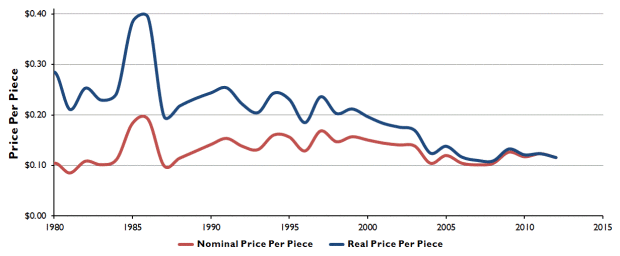
On the other hand, a lot what the company does today just sucks. Set prices are outrageous. Printed bricks get replaced with stickers and many sets feel like display models than something you can play with. The Mindstorms/NXT line had huge potential but then just sort of fizzled out. And the push towards smartphone-dependent toys feels weird. Who actually wants their kids staring at a phone to play Lego?
It's so sad, because the core product is basically perfect.