Legally, you are right. Morally and practically, I'm not so sure. Few hearts and minds are changed as a result of the supreme court's rulings, just the code powering the justice system. Convincing 5 of the top judges is easy compared to convincing the populace, and the latter is more important for the long term goals of equality.
Federally legislated social change pushes back the more important goals of social equality and cultural integration. These are arguably more important, as our interactions with marriage laws are a relatively minor part of our lives when compared to our interactions with other people.
The historical precedent here is clear, of course - there are no and have been no segregation laws in America for decades as a result of federal action, but you'd be silly to say that segregation does not exist in America.
> Today's decision pushes back the more important goals of social equality and cultural integration. ... there are no and have been no segregation laws in America for decades as a result of federal action, but you'd be silly to say the result was that segregation does not exist in America.
As a counterpoint: Since the civil rights era, the welfare and integration of the black-skinned Americans has improved dramatically. Some argue that desegregation alienated more hearts and minds than it helped, but I've yet to see any evidence. Certainly American opinions about blacks also have changed dramatically. (But I agree that we do have a long way to go.)
> No hearts and no minds are changed as a result of the supreme court rulings, just the code powering the justice system ...
I'm not sure no hearts and minds were changed -- I suspect many will reconsider, having seen the decision of a respected institution and the direction of society -- but I agree that you can't do that by court order. But there is a very substantive change: Gay Americans now can get married!
Good points. "Few hearts and minds" is more accurate.
> Some argue that desegregation alienated more hearts and minds than it helped, but I've yet to see any evidence.
It's a question that isn't easy to answer empirically, but it's not outside of the realm of possibility that we would today have a less segregated of a society if segregation had come been eradicated in each community separately and via local and state laws rather than federal action.
All that aside, I think legal equality is a worthy cause and a great victory on its own. I hope we do not forget about social equality and cultural integration as worthy causes, as well.
> No hearts and no minds are changed as a result of the supreme court rulings, just the code powering the justice system.
A lot of the "hearts and minds" you talk about are animated by "tradition", which is often code for "continuing to do the thing I grew up with". The legal code changes what people grow up with, thereby changing future hearts and minds.
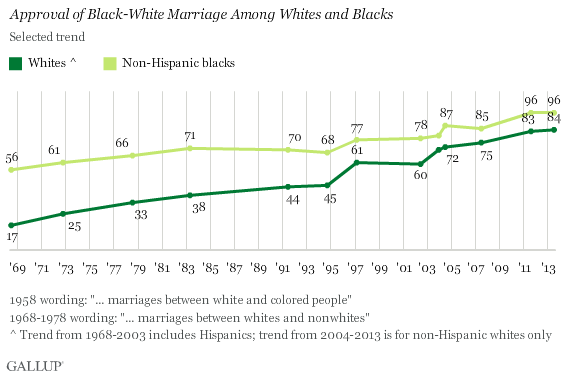
Take a look at the graph of approval rates of interracial marriage:
Some of the change there is changing hearts and minds. But a lot of it is just the replacement of bigoted hearts and minds with new ones.
As Max Planck wrote, "A new scientific truth does not triumph by convincing its opponents and making them see the light, but rather because its opponents eventually die, and a new generation grows up that is familiar with it."
And if that's true for science, it's much more so for cultural things like this. I think there's little point in continuing to harm GLBT families in the hopes of preserving the delicate feelings of people who were unlikely to change anyhow.
On the flip side, SCOTUS rulings have the power to accelerate trends already happening in society. Making segregation in schools and in housing illegal does not eliminate racism. But it does lead to a generation of people that aren't raised in schools and neighborhoods that only have people of one race.
> Today's decision pushes back the more important goals of social equality and cultural integration. These are arguably more important, as our interactions with marriage laws are a relatively minor part of our lives when compared to our interactions with people.
We've proven as a society that this won't happen without administrative action being taken from the top.
The legality has real consequences for people right this second, so waiting for the tide of change is absurd to ask of those that are affected.
Both fronts can be attacked simultaneously.
Though, I do agree there is a trend to pass a stopgap measure and to then pretend the problem is fixed.
This is a logically-consistent line of thought that---inconveniently---doesn't seem to align with evidence.
Historically, it seems to be the case that when society legalizes something, and people can observe that under that new order, society doesn't crumble, societal attitudes on the morality of that thing change to reflect the reality (albeit slowly).
Consider women's suffrage. Consider no-fault divorce. Consider black men and white men being forced to serve side-by-side in WWII by the draft, then coming home to a country that still treated them unequal in the eyes of the law.
It's not a 100% consistent scenario (contrast abortion rights debate in the wake of Roe v. Wade), but the trend is for culture to adapt in the face of evidence.
No hearts and no minds are changed as a result of the supreme court rulings, just the code powering the justice system.
This assumes that peoples' moral judgments aren't influenced by societal opinion and that societal opinion isn't influenced by laws and the opinions of its leaders/elites. That seems like a tough case to make.
Today's decision pushes back the more important goals of social equality and cultural integration.
Hearts and minds are more easily influenced by the status quo than one might think. People whose opposition wasn't obsessive tend to take note of the fact that they know some friends of friends who had one of those gay marriages and they're apparently very happy, whilst their pastor who gave such eloquent warnings about the impending moral breakdown of America whilst the anti-gay-marriage ballot initiatives were being drawn initiatives has changed the subject of his moral crusade to something else, and above all it doesn't really doesn't seem worth revisiting the issue or worrying about homosexuals at all when they could be mobilizing to save unborn babies, their constitutional right to lethal weaponry or the immortal soul of their atheist nephew. When change is less drastic than you feared, it becomes easier to accept than you anticipated.


Federally legislated social change pushes back the more important goals of social equality and cultural integration. These are arguably more important, as our interactions with marriage laws are a relatively minor part of our lives when compared to our interactions with other people.
The historical precedent here is clear, of course - there are no and have been no segregation laws in America for decades as a result of federal action, but you'd be silly to say that segregation does not exist in America.